Roulette Online: How to Play, Rules, Odds, Live Dealer and Real Money Options (2026 Guide)

Last reviewed: July 2026 | Reading time: ~18 minutes

Roulette looks simple. One wheel, one ball, dozens of ways to bet. That simplicity is exactly why so many guides skip the parts that matter: which wheel you are actually playing, what a bonus does to your turnover, and what the law says about real-money play in Australia. This guide covers all three, plus the practical mechanics of deposits, verification and withdrawals.

About the author and how we

About the author and how we review roulette sites

Claire Bennett, senior casino content editor. Claire is our editorial persona for Australian English casino coverage, and every roulette page on this site is written to her review method: terms first, benefits second. The focus sits on the maths behind wheel games, the gap between marketing claims and audited return-to-player figures, and the friction points players actually hit at cash-out.

How we assess a roulette site. Every platform mentioned on this page is measured against eight criteria: licence validity (Malta Gaming Authority, Curaçao, Anjouan, Tobique and similar regulators), payout speed (instant to 72 hours preferred), published or independently audited RTP, KYC and verification requirements, bonus wagering terms (x40 or lower), live stream stability (1080p at 60fps), table limit range from low-stake to high-roller, and working responsible-gambling tools such as deposit limits and self-exclusion.

One more thing we check, and it is easy to overlook: whether roulette actually counts towards the bonus you are being offered. Often it does not.

For further reading on how licensed operators, providers and payment systems fit together, see our overview of the iGaming industry.

What an Australian player needs to

What an Australian player needs to know in 60 seconds

  • Roulette is a game of pure chance. No betting system removes the built-in mathematical advantage held by the house.
  • Pick the wheel with one zero. European roulette carries a 2.70% house edge, French roulette drops to 1.35% on even-money bets thanks to La Partage, and American roulette doubles the disadvantage to 5.26%.
  • A straight-up number pays 35:1, not 37:1. Payout and probability are two different things, and we explain the difference below, because several popular guides get it wrong.
  • Real-money online casino games cannot legally be offered to people physically located in Australia under the Interactive Gambling Act 2001. The prohibition targets operators, not players, which is why offshore platforms dominate this market.
  • Credit cards and digital currency are prohibited as payment methods for interactive wagering services in Australia, with the ban fully in force from 11 June 2024.
  • Roulette usually contributes 0–10% towards bonus wagering requirements. Read the terms before you accept an offer, or your withdrawal may be voided.
  • Casino table games have the highest concentration of gambling harm of any product measured in recent Australian surveys, despite relatively low participation.
  • Free help is available 24/7: 1800 858 858 or gamblinghelponline.org.au. National self-exclusion is available through BetStop.

On this page

  1. Understanding roulette: structure, variants and spin resolution
  2. Rules, bets, odds, payouts and house edge
  3. Online roulette, live dealer, real money and the regulatory context
  4. Bonuses, wagering requirements and roulette game weighting
  5. Payments, withdrawals and KYC in Australia
  6. Participation, online behaviour and harm
  7. Choosing games and casinos: safety, payments, mobile access
  8. Strategy, odds-based play and responsible gambling
  9. FAQ about playing roulette online
  10. Conclusion

1. What Is Roulette and How Does the Game Work?

Roulette is the most recognisable wheel game in the world, and the structure of the game explains almost everything about its risk profile. This section covers what the game physically consists of, how the three main variants differ, and exactly how a spin is resolved.

Roulette wheel, roulette table and the

Roulette wheel, roulette table and the basic round

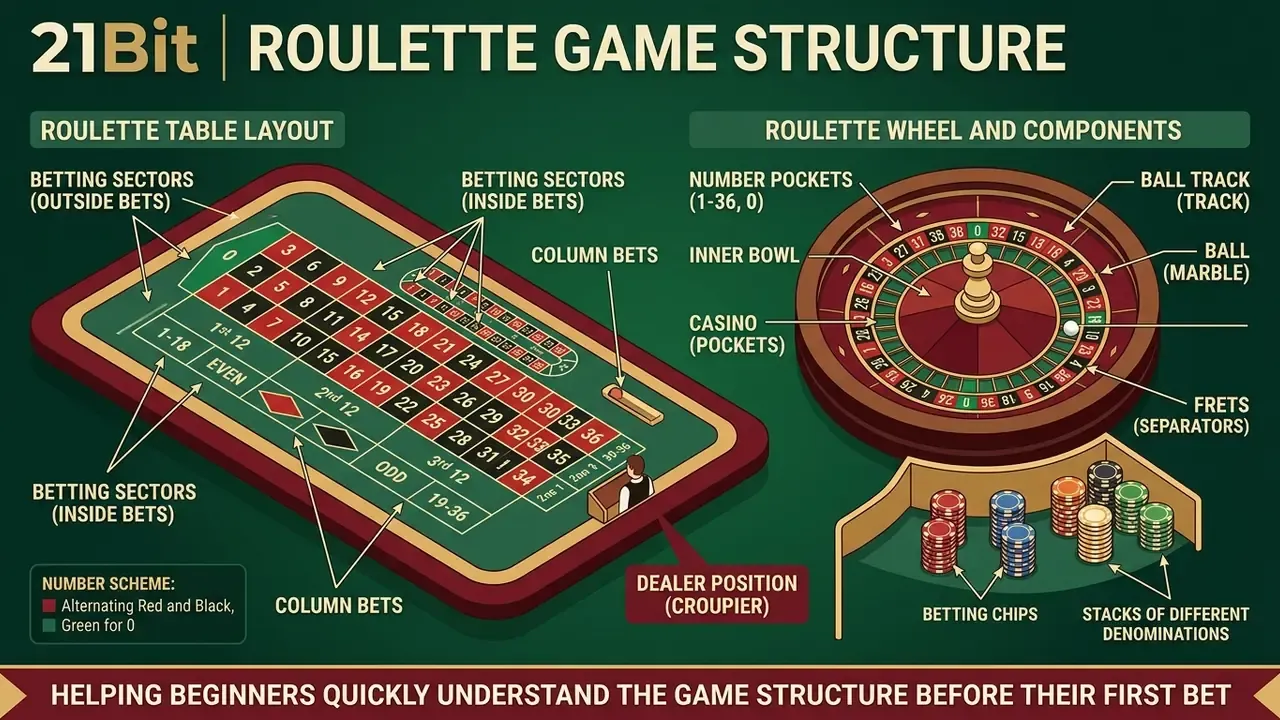
Roulette is a casino table game played with a numbered wheel, a ball and a betting layout. Players place chips on single numbers, groups of numbers or broad categories such as red/black, odd/even and high/low. Once betting closes, the wheel is spun, the ball is released against the direction of rotation, and the pocket in which the ball settles determines every winning and losing wager on the table.

The critical structural feature is the zero. A European wheel carries 37 pockets, numbers 1 to 36 plus a single zero, while payouts are calculated as though only 36 outcomes existed.

That gap between true probability and payout is the mathematical foundation of the game, and it ensures the casino will almost always profit in expectation.

Playing roulette, in other words, means accepting a fixed statistical cost in exchange for entertainment. Nothing about the layout hides that. It is printed in the paytable.

«Casino table games show the highest concentration of moderate- to high-risk gamblers: 19.2% of participants, compared with 5.8% across all gamblers.» Source: NSW Gambling Survey 2024, Central Queensland University / NSW Responsible Gambling Fund. https://www.gambleaware.nsw.gov.au

«A European roulette wheel has 37 pockets and a single zero, giving the casino a 2.7% advantage on every bet over the long run.» Source: The science of the casino: why the house always wins in the long run, University of Melbourne (2023). https://pursuit.unimelb.edu.au

A house edge of 2.7% means the casino expects to win 2.7 cents for every AU$1 bet over the long run. That figure does not shift with your betting pattern, your streak, or the time of day.

European, American and French roulette variations

Three classic variants dominate both land-based venues and online lobbies. They look similar. The difference in expected cost to the player is not similar at all.

ParameterEuropeanFrenchAmerican
Number of zeros1 (0)1 (0)2 (0, 00)
Total pockets373738
House edge2.70%1.35% on even-money bets (2.70% otherwise)5.26%
RTP97.30%98.65% on even-money bets94.74%
Special rulesNoneLa Partage / En PrisonNone
Straight-up payout35:135:135:1
Chance of a straight-up win1 in 37 (2.70%)1 in 37 (2.70%)1 in 38 (2.63%)

Why the American wheel costs more. On a European wheel there are 37 equally likely outcomes, so an even-money bet wins 18 times out of 37 and the player's expectation is reduced by 1/37 of the stake:

1/37 = 0.027, or 2.7%

On an American wheel the added double zero produces 38 outcomes without any increase in payout, so the shortfall becomes 2/38 = 0.0526, or 5.26%. One extra pocket almost doubles the long-run cost of play. If both wheels sit in the same lobby, there is no rational reason to open the American one.

«An online roulette tracker shows that at 12 spins in five minutes, expected losses on a European wheel are about AU$0.32 for every AU$10 staked.» Source: Online roulette tracker, NSW-based training institute (2023). https://www.gambleaware.nsw.gov.au

Rule note, La Partage. If the

Rule note, La Partage. If the ball lands on zero, the player loses only 50% of an even-money stake (red/black, odd/even, high/low). That single rule cuts the house edge on those bets to 1.35%, the best mathematical deal available anywhere in roulette.

Rule note, En Prison. Instead of returning half the stake, the casino "imprisons" the full even-money bet for one additional spin. If the following spin wins, the stake is released without profit; if it loses, the stake is forfeited. Over time this produces a similar reduction in house advantage to La Partage on eligible bets.

Beyond the classics, online lobbies also offer Mini Roulette (a 13-pocket wheel with a notably higher house edge), multi-wheel roulette, double-ball formats and auto roulette. Check the paytable and the number of zeros before your first spin, because "roulette" is a family of games rather than one fixed product.

How a roulette spin is settled

How a roulette spin is settled and dealer actions

A round follows a fixed sequence in both live studios and land-based venues:

  1. Betting window opens. Players place chips on inside and outside positions on the layout.
  2. Dealer calls "no more bets". In live dealer games this is announced verbally, usually with a hand gesture, and the digital betting grid locks.
  3. Wheel and ball are released. The ball travels against the wheel's rotation and gradually loses momentum.
  4. Ball settles and the winning number is announced. The dealer marks the winning pocket with a dolly.
  5. Losing chips are cleared, winners are paid according to the fixed payout for each bet type.
  6. The dolly is removed and the next betting window opens.

In RNG roulette the same visual sequence is animated, but the outcome is determined by a certified random number generator at the moment the spin is triggered. In both cases each spin is statistically independent of every previous spin.

Australian enforcement activity is relevant here, because plenty of unlicensed products dress themselves up as legitimate live studios.

«ACMA had 50 additional websites blocked in April to June 2024 for offering illegal casino services, including roulette, without an Australian licence.» Source: ACMA, Action on interactive gambling: April to June 2024. https://www.acma.gov.au

Those blocking requests cover prohibited services such as roulette, slots and poker, plus alternate sites set up to evade earlier blocks.

2. Roulette Rules, Bets, Odds, Payouts and House Edge

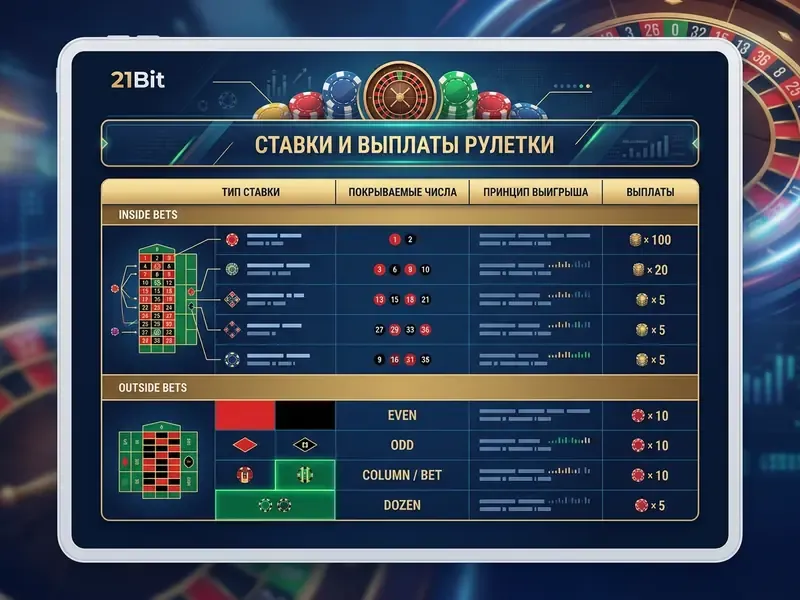
Roulette bets divide into two families: inside bets placed on individual numbers or small clusters, and outside bets placed on large groups. Inside bets pay more and win less often; outside bets pay less and win more often. Neither category changes the house edge on a single-zero wheel.

Inside roulette bets: straight, split, street and corner

BetNumbers coveredWhere the chip goesPayout
Straight / Single1Centre of the number35:1
Split2Line between two adjacent numbers17:1
Street3Outer edge of a row of three11:1
Corner (Square)4Intersection of four numbers8:1
Six Line (Double Street)6Junction of two adjacent street lines5:1

Outside roulette bets: red/black, odd/even, dozens and columns

BetNumbers coveredWin probability (European)Win probability (American)Payout
Red / Black1848.65%47.37%1:1
Odd / Even1848.65%47.37%1:1
High (19–36) / Low (1–18)1848.65%47.37%1:1
Dozen (1–12, 13–24, 25–36)1232.43%31.58%2:1
Column1232.43%31.58%2:1

French tables also offer "called" or announced bets covering wheel sectors: Voisins du Zéro, Tiers du Cylindre, Orphelins and Jeu Zéro. These are combinations of standard inside bets, so they carry the same 2.70% edge. They simply spread multiple chips in one instruction.

How payouts depend on the roulette

How payouts depend on the roulette bet

Payout and probability get confused constantly, including by large comparison sites. Correction, and this matters: a straight-up win pays 35 to 1 on both European and American wheels. The chance of hitting that number is 1 in 37 (2.70%) on a European wheel and 1 in 38 (2.63%) on an American wheel. Claims that a single number carries "37 to 1 odds" on a European wheel, or "38 to 1" on an American wheel, confuse the number of pockets with the payout ratio. True fair odds on a European wheel would be 36:1. The casino pays 35:1, and the missing unit is the house edge.

The inverse relationship holds across the whole layout: the rarer the outcome, the larger the multiplier. A straight-up bet returns 35 units of profit but wins less than 3% of the time, while red/black returns 1 unit and wins just under half the time.

Bankroll volatility follows the same curve. Inside bets produce sharp swings; even-money bets erode a balance more slowly and more predictably.

High-variance inside bets can create the impression of dramatic "comebacks" when one large win temporarily offsets earlier losses. That impression can encourage longer sessions and bigger stakes. The mechanism is well recognised in harm-reduction practice, and the frequency data is unambiguous:

«50.1% of monthly casino table-game players experienced moderate- to high-risk gambling, compared with 16.4% of less frequent players.» Source: NSW Gambling Survey 2024, Central Queensland University / NSW Responsible Gambling Fund. https://www.gambleaware.nsw.gov.au

Independent verification of that "comeback" effect specifically in roulette would need product-level session data that is not currently published in Australia. Treat it as a plausible mechanism supported by frequency-of-play evidence, not a proven causal finding.

Table limits, chip denominations and placement

Table limits, chip denominations and placement rules

Every table publishes a minimum and maximum bet, and limits often differ between inside and outside positions. A table may accept AU$1 on a straight-up number but require AU$5 on red/black, with a much higher ceiling on even-money bets.

  • Chip denominations online typically start at AU$0.10–AU$1 and rise to AU$500 or more at VIP tables.
  • Placement is confirmed by the interface, not the dealer, in both RNG and live formats; misplaced chips can usually be undone until the betting window closes.
  • Maximum bet caps are the single most important practical constraint on progressive betting systems, as explained in section 8.
  • Bonus play often carries a separate maximum bet clause (frequently AU$5–AU$10 per spin), and breaching it can void winnings even when you win fairly.

3. Roulette Online, Live Dealer and Casino Roulette: What Is the Difference?

There are three delivery formats, and they behave quite differently in practice.

CriterionRNG rouletteLive dealer rouletteLand-based casino
DealerNone; software outcomeReal croupier on videoReal croupier in person
Pace~300–500 spins per hour possible~30–50 spins per hour~30–40 spins per hour
Fairness controlCertified RNG (eCOGRA, iTech Labs, GLI)Physical wheel, studio audit, game logsLicensed table operations, wheel inspection
Demo modeUsually availableRarely availableNot applicable
Minimum stakeOften AU$0.10–AU$1Typically AU$1–AU$5Frequently AU$10–AU$25
Maximum stakeModerateOften higher (attracts high rollers)Varies by venue and pit
Connection needsStandard connectionStable broadband for real-time videoNone
AtmosphereScreen-only, solitaryReal dealer, chat, social presenceFull physical environment

The pace column deserves attention. Faster spin cycles mean more decisions per hour, and therefore more exposure to the house edge in the same amount of time. Fast RNG tables let a bankroll turn over far quicker than a slower live table. We would frame that as arithmetic, though, not as a proven difference in harm outcomes, since no current Australian study isolates RNG spin speed as an independent risk factor.

«Participation has increased for lottery tickets, sports betting and online casino games, while EGM, scratchie, race betting and casino table-game participation declined.» Source: NSW Gambling Survey 2024, Central Queensland University / NSW Responsible Gambling Fund. https://www.gambleaware.nsw.gov.au

RNG online roulette games

RNG roulette is software-only. No croupier, no studio, no waiting for other players. The wheel animation is decorative; the result comes from a certified random number generator the instant you press spin.

Two practical consequences. Free roulette in demo mode is nearly always available, which makes RNG tables the easiest place to learn the layout. And the pace is entirely yours, which is exactly why a session timer helps more here than anywhere else in the lobby.

Live dealer roulette, show formats and

Live dealer roulette, show formats and multipliers

The live segment has moved well beyond a straight broadcast of a classic wheel. Contemporary formats add random multipliers and heavier presentation:

  • Lightning Roulette applies random "lightning" multipliers to one or more straight-up numbers each round, commonly from x50 to x500. Straight-up payouts are reduced (typically to 29:1) to fund the multiplier, so the underlying RTP on those bets sits below a classic wheel. Many guides omit that trade-off. Source: Evolution. https://www.evolution.com
  • Immersive Roulette uses multiple cameras and slow-motion replays of the ball drop, with a deliberately cinematic pace. Source: Evolution. https://www.evolution.com
  • Quantum-style and multiplier hybrids stack randomly generated multipliers that can reach x500–x1000 on selected numbers.
  • Auto Roulette removes the dealer while retaining a physical wheel, delivering higher spin frequency than a dealt table.
  • Double Ball and Multi-Wheel formats change the probability structure entirely; read the specific paytable each time.

Side-bet rich formats amplify variance in both directions. When a multiplier table cuts the base payout on inside bets, the entertainment value rises and the mathematical expectation usually falls. Worth knowing before you sit down.

Roulette demo, free play and real-money

Roulette demo, free play and real-money games

Demo roulette uses virtual credits. It is genuinely useful for three things: learning the layout, testing how an interface handles chip placement and undo functions, and watching how a betting system behaves over a few hundred spins without financial exposure. It is useless for predicting results, because demo outcomes are as independent as real ones.

Before switching to real-money roulette, verify: licence and operator identity, table limits at your stake level, bonus terms and roulette weighting, accepted deposit and withdrawal methods, KYC requirements, and available responsible-gambling controls. In most interfaces, demo and real-money modes sit behind two separate entry points, "Play for fun" and "Real money", and the real-money session needs a logged-in account with a funded balance. Some games will not allow a mid-session switch until the current bet is resolved.

Free play is not a risk-free pipeline, either. Research on pathways into online gambling highlights exposure to free or low-risk gambling experiences that later escalate into real-money play, particularly among younger cohorts.

«27% of ACT respondents aged 18–29 had gambled online in the previous 12 months.» Source: Young Adults Gambling Online in the ACT, Australian National University / ACT Gambling and Racing Commission, February 2024. https://www.gamblingandracing.act.gov.au

Australian law the Interactive Gambling Act

Australian law: the Interactive Gambling Act, ACMA and offshore sites

Under the Interactive Gambling Act 2001, operators are prohibited from offering casino-style games for real money, including online roulette, blackjack, poker and pokies, to people physically located in Australia. The key nuance: the law targets the companies providing the service, not individual players.

That produces a three-way split in legal status:

  • Land-based casino roulette is regulated state by state and can be offered legally in licensed venues. Rules, available venues and responsible authorities differ across New South Wales, Victoria, Queensland, Western Australia, South Australia, Tasmania, the ACT and the Northern Territory.
  • Free-play roulette with no deposit and no cash payout falls outside the prohibition.
  • Real-money online roulette cannot lawfully be supplied to people in Australia by any operator, which is why offshore platforms fill the demand.

Understanding offshore licences. Offshore status by itself does not make a casino fraudulent. What matters is which jurisdiction supervises the operator, and where you can escalate a dispute when something goes wrong.

21Bit heading-banner
  • Malta Gaming Authority (MGA):the most demanding of the commonly seen regulators, with detailed player-funds and complaints requirements. The MGA's Remote Gaming Services section is the reference point for B2C remote licences.
  • Curaçao, Anjouan, Tobique:international regulators that verify RNG integrity and require encrypted connections, with lighter ongoing supervision than the MGA or the UK Gambling Commission.
  • Unlicensed script sites:no audit certificates from eCOGRA, iTech Labs or GLI. On these platforms, spin results can be manipulated and there is no complaints body at all.

Australian regulators do not extend the same consumer protection to offshore sites that they extend to locally licensed gambling services. Before registering, check company ownership, licence validity, the named complaints body, KYC rules, payout conditions and the stated policy on Australian users.

Since 30 March 2023, seven mandatory taglines have replaced the older "Gamble responsibly" message across online wagering advertising where taglines are required.

Payment restrictions tightened at the same time.

Disclaimer. This information is general in nature and does not replace professional advice. Gambling involves a real risk of financial loss. If gambling is causing you problems, free and confidential help is available: call 1800 858 858 or visit gamblinghelponline.org.au.

4. Bonuses, Wagering Requirements and Roulette Game Weighting

This is where most roulette players lose winnings they thought they had already earned. Bonus terms rarely treat the wheel the way they treat pokies.

Game typeTypical contribution to wagering
Pokies / slots100%
Keno, scratch games100%
Roulette (RNG)5–20%, sometimes 0%
Live dealer rouletteFrequently 0% (excluded)
Blackjack5–10%
Video poker, baccarat0–10%
Worked example. You accept a AU

Worked example. You accept a AU$200 bonus with a x40 wagering requirement. That is AU$8,000 of turnover on pokies. If roulette contributes only 10%, every AU$1 wagered on the wheel counts as AU$0.10, so you would need AU$80,000 of roulette turnover to clear the same bonus. At a 2.70% edge, the expected cost of that turnover dwarfs the bonus itself.

Terms that commonly void roulette winnings:

  • Covering both sides, betting red and black, or odd and even, at the same time to generate turnover with minimal risk. Almost universally banned as "low-risk" or "equal-bet" wagering.
  • Covering 67% or more of the layout in a single round.
  • Exceeding the maximum bet during bonus play (often AU$5–AU$10 per spin).
  • Playing excluded games while a bonus balance is active, even accidentally.
  • Bonus expiry, since many offers run 7–30 days, which is rarely enough time at roulette weighting.

Practical rule: if you plan to play roulette, either decline the bonus or pick an offer with low or zero wagering. A no-wager welcome offer is worth more to a roulette player than a headline 250% match with x40 terms. That is not a small difference. It is the whole difference.

  1. Payments, Withdrawals and KYC for Australian Players

MethodDepositWithdrawalTypical timeframeNotes
PayID / OskoYesSometimesDeposits near-instant; payouts 1–3 business daysConvenient locally; availability varies by operator
Debit card (Visa/Mastercard)YesLimited1–5 business daysCredit cards prohibited for interactive wagering since 11 June 2024
Neosurf / prepaid vouchersYesNoInstant depositDeposit-only; alternative payout method required
Bank transferYesYes3–5 business daysHigher limits, slowest option
Cryptocurrency (BTC, ETH, USDT)YesYesMinutes to 24 hoursProhibited as a payment method for licensed interactive wagering services in Australia; volatility and network fees apply
E-walletsVariesVariesSame day to 48 hoursAvailability differs by jurisdiction and operator
KYC before your first withdrawal. Expect

KYC before your first withdrawal. Expect to supply photo ID, proof of address dated within three months, and proof of the payment instrument used. Verification usually takes 24–72 hours and is normally triggered at first cash-out rather than at registration. Two practical points: submit documents before you win, and make sure the account name matches your ID exactly. Name mismatches are the most common cause of payout delays we see in complaint threads.

Withdrawal limits matter as much as speed. A casino advertising instant payouts with an AU$4,000 weekly ceiling behaves very differently from one paying in 72 hours with an AU$50,000 limit. Read both numbers together, never one in isolation.

6. Roulette Participation, Online Gambling Behaviour and Harm

Prevalence and risk among casino table-game players

Casino table games are a minority product with a disproportionate harm profile. Men were more likely to play casino table games (6.7%) than women (2.0%), with the highest participation rate among young men aged 18–24 (14.6%).

«Participation in casino table games reaches 14.6% among men aged 18–24, the highest rate of any NSW demographic group surveyed in 2024.» Source: NSW Gambling Survey 2024, Central Queensland University / NSW Responsible Gambling Fund. https://www.gambleaware.nsw.gov.au

Two factors drive the elevated risk: frequency of play and session length. Monthly-or-more players show roughly three times the rate of moderate- to high-risk gambling compared with occasional players.

Online casino games and changing gambling patterns

Online delivery changes the behavioural picture. Sessions can start anywhere, at any hour, with no venue closing time and no cash-handling friction. Operators increasingly deploy machine-learning systems in both directions, for marketing and for harm detection. Harm-detection tools may monitor rising bet sizes, loss chasing or extended sessions, then trigger interventions such as pop-up warnings or limit enforcement.

«ACMA identifies four applications of AI in gambling: predictive analytics, personalised promotions, content creation and harmful-behaviour detection.» Source: ACMA, AI and interactive gambling sector developments report, 2026. https://www.acma.gov.au

The same technology that flags risky patterns can also target promotional offers at the players most likely to respond. Which is precisely why player-side controls, rather than operator goodwill, remain the reliable safeguard.

7. How to Choose the Best Roulette Casino Online

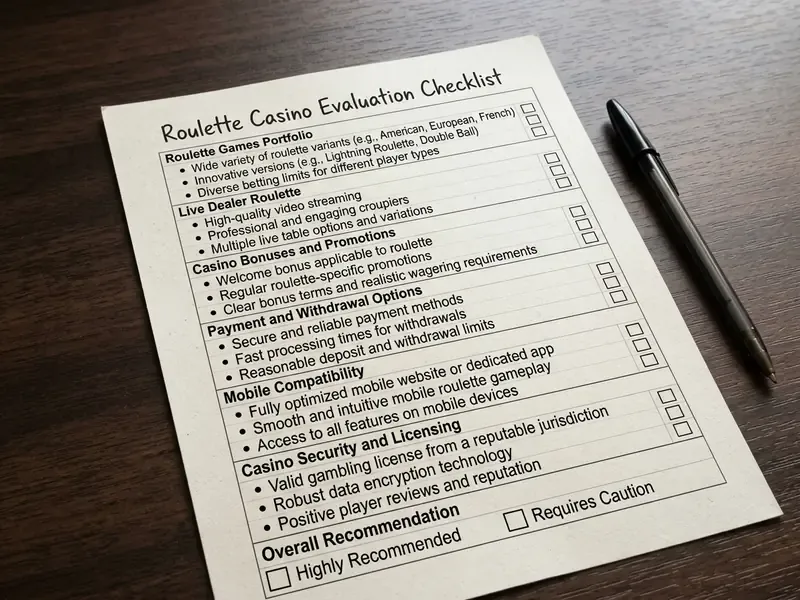
The checklist to work through before

The checklist to work through before you deposit

Do not judge a site by its bonus headline or its game count. Work through these eight points first.

  1. Licence and ownership. A named licence number, verifiable in the regulator's register, matched to a real corporate entity.
  2. Independent audit. Certificates from eCOGRA, iTech Labs or GLI covering the RNG and published RTP.
  3. Availability for Australia. Registration, deposits and gameplay without regional restriction; confirm that your preferred tables, payment methods and support channels are genuinely accessible.
  4. Roulette range and limits. European, French, American, auto, live dealer and multiplier tables from recognised providers, with minimum and maximum bets that suit your budget.
  5. Payments in both directions. A convenient deposit does not guarantee an easy withdrawal, so check payout methods, limits, fees, processing times and refund policy separately.
  6. Bonus rules. Wagering multiple, maximum bet during bonus play, validity period, eligible games and roulette contribution percentage.
  7. Responsible-gambling tools. Deposit limits, loss limits, session reminders, cool-off and self-exclusion, all self-service and effective immediately.
  8. Support quality. Test live chat with a specific question about withdrawal limits before you register. Vague answers are a reliable red flag.

Enforcement statistics are a useful reminder of how much of this market is non-compliant. In January to March 2023 alone, ACMA investigated 21 sites, found 20 breaches of the Interactive Gambling Act 2001, and referred 56 websites to internet service providers for blocking (ACMA, Action on interactive gambling: January to March 2023, https://www.acma.gov.au). Choosing recognisably licensed operators is the single most effective filter a player has.

Comparison matrix: verified roulette platforms

CasinoMinimum depositBonus wageringPayout speedLicenceWithdrawal limit
Mafia Casino$15 (bonus min. A$30)x35Up to 72 hoursAnjouan$35,000
JeetcityA$30x403–5 business daysCuraçaoA$30,000
Winz.ioA$45x0 (no wagering)InstantTobiqueUSD 100,000 per week

For roulette specifically, the no-wagering column is the most valuable field in this table. A x40 requirement combined with 10% roulette weighting makes a bonus effectively unusable on the wheel. Terms change, so confirm the current version on the operator's page before you act.

Roulette casinos on our sites-to-avoid list

We only mention platforms we would use ourselves. The three below are examples of a profile to avoid, and the reasons are more instructive than the names.

CasinoRatingPrimary reason for blacklistingPayout status
GrandBay Casino1.2 / 10Withdrawal delays exceeding 18 months; unresponsive supportAccounts locked
BetRockers1.5 / 10Winnings voided citing unclear wagering conditionsDelayed indefinitely
Virtual Casino1.0 / 10Uncertified, script-based software with no audit trailPayment refused

Recurring red flags: misleading licensing claims, scripted or evasive customer service, accounts locked without notice, winnings confiscated under retrospectively applied terms, and no named complaints body.

Mobile roulette gaming and internet connection

Mobile roulette gaming and internet connection requirements

Roulette is one of the most mobile-friendly casino formats. A betting layout scales well to a touchscreen, and both portrait and landscape modes are widely supported on iOS and Android through HTML5. Practical requirements:
  • Connection speed:4 Mbps minimum for live streaming; 12 Mbps or more for smooth 1080p at 60fps.
  • Latency:under 50 ms to the studio server, so the "no more bets" window does not close before your chips register. Bandwidth and latency are separate constraints, and a fast connection with high jitter will still cost you bets.
  • Device:any modern HTML5 browser (Chrome, Safari, Firefox, Edge) with at least 4 GB RAM. A phone that handles video calls comfortably will handle live roulette.
  • Stability over speed:dropping mid-spin on a mobile network is worse than playing at slightly lower resolution. Wi-Fi generally beats mobile data for live tables.

The convenience of mobile play carries a behavioural cost.

«Regular online gamblers frequently bet across multiple contexts, and mobile access blurs the boundary between leisure and risk.» Source: Australian Institute of Family Studies, National Gambling Trends Study, 2023. https://aifs.gov.au

8. Roulette Strategy, Odds-Based Play and Responsible Gambling

Betting systems Martingale, D'Alembert, Fibonacci and

Betting systems: Martingale, D'Alembert, Fibonacci and table limits

Betting systems are the most heavily marketed and least effective part of roulette culture. They redistribute variance. They do not touch expectation.

1. Martingale. Double the stake after every loss so that one win recovers all prior losses plus a unit. Failure mode: the table maximum. Starting at AU$5 with a AU$500 ceiling allows only seven consecutive doublings (5, 10, 20, 40, 80, 160, 320, since the eighth step of 640 is rejected). Eight losing spins on an even-money bet is far from rare, and it costs AU$635 to chase AU$5.

2. D'Alembert. Increase the stake by one unit after a loss and decrease it by one unit after a win. Trade-off: a much gentler progression suited to a limited bankroll, though the slower recovery means losing sequences can drag on without resolution.

3. Fibonacci. Follow the sequence 1–1–2–3–5–8–13–21, stepping forward on a loss and back two places on a win. Trade-off: slower escalation than Martingale, but the same structural wall, because the sequence grows geometrically and the table maximum does not move.

4. Flat betting. The same stake every spin. Boring, transparent, and the only approach whose expected cost is exactly the house edge multiplied by turnover, with no hidden ruin risk from progression.

Choose variations and bets with odds

Choose variations and bets with odds in mind

If you are going to play, play the wheel with the smallest edge and stay honest about volatility. French roulette with La Partage on even-money bets is the best available deal at 1.35%. European is next at 2.70%. American at 5.26% should be skipped whenever an alternative sits in the same lobby. Even-money bets carry lower variance than straight-up numbers, so a fixed bankroll survives longer at the same stake. Survival time is not profit, though.

Progressions such as Martingale or Fibonacci may reshape short-run variance, yet they cannot change expected value, because each spin is independent and the house edge applies universally.

«Every roulette spin is independent, and no betting system changes expected value: the 2.7% house advantage applies to every bet on a European wheel.» Source: The science of the casino, University of Melbourne (https://pursuit.unimelb.edu.au); Online roulette tracker, NSW training institute (https://www.gambleaware.nsw.gov.au)

Set limits and avoid common roulette

Set limits and avoid common roulette mistakes

The four mistakes that cost the most money:

  1. Gambler's fallacy. After eight reds, black is not "due". The wheel has no memory, and each spin keeps identical probabilities.
  2. Chasing losses. Raising stakes to recover a deficit turns a small loss into a large one at speed.
  3. Ignoring table limits. Any progression fails at the maximum bet, and that is exactly the moment it is most needed.
  4. Treating roulette as a skill game. Bet selection and progression shape the experience, not the underlying odds. Marketing that presents roulette as a game of skill would be misleading in an Australian consumer protection context, and the National Consumer Protection Framework requires harm-reduction messaging precisely because outcomes are not within player control.

Practical controls, in order of usefulness:

  • Set a deposit limit before your first session, not after a loss.
  • Set a loss limit per session and a time limit per day.
  • Use cool-off periods after any session that felt out of control.
  • Register with BetStop, the National Self-Exclusion Register, to block access to licensed Australian wagering services across the board (betstop.gov.au).
  • Never gamble with borrowed money, a principle now reinforced by the statutory credit-card prohibition.

The DSS taglines explicitly encourage pre-commitment ("What are you prepared to lose today? Set a deposit limit."), and harm-reduction guidance supports limit-setting as a way to blunt impulsive decisions mid-session.

«Licensed operators must display a call to action alongside each harm message: "For free and confidential support call 1800 858 858 or visit gamblinghelponline.org.au".» Source: Department of Social Services, National Consumer Protection Framework, consistent gambling messaging factsheets. https://www.dss.gov.au

Disclaimer. This information is general in nature and does not replace professional advice. Gambling involves a real risk of financial loss, and no strategy described here can produce a long-term profit. If you are experiencing problems with gambling, free confidential help is available: 1800 858 858 or gamblinghelponline.org.au.

  1. FAQ About Playing Roulette Online

10. Conclusion Reading the Maths Before

  1. Conclusion: Reading the Maths Before You Read the Bonus

Roulette rewards an understanding of its structure far more than any tactical cleverness. The decisions that genuinely change a player's outcome are structural: choose a single-zero wheel, prefer La Partage tables where they exist, avoid the American double zero, read the bonus weighting before accepting an offer, verify the licence before depositing, and set deposit and loss limits before the first spin rather than after a bad one.

Australian survey data points the same way. Casino table games, roulette included, show relatively low participation but a high concentration of moderate- to high-risk gamblers, especially among people who play at least monthly and stay in long sessions.

«Only 4.3% of NSW adults played casino table games in 2024, yet 19.2% of them showed moderate- to high-risk gambling, the highest rate of any gambling product.» Source: NSW Gambling Survey 2024, Central Queensland University / NSW Responsible Gambling Fund. https://www.gambleaware.nsw.gov.au

Modest reach, concentrated harm. That combination

Modest reach, concentrated harm. That combination is why any credible guide to online roulette has to publish the maths, the legal position and the support pathways alongside the game descriptions. The house edge is not a marketing detail. It is the product.

Final disclaimer. This article is general information only and is not legal, financial or medical advice. Gambling carries a genuine risk of financial loss, and no variant, bet or system offers a long-term mathematical advantage to the player. You must be 18 or over. For free, confidential 24/7 support in Australia, call 1800 858 858 or visit gamblinghelponline.org.au. To self-exclude from licensed Australian wagering services, register with BetStop at betstop.gov.au.