Online Blackjack in Australia: Rules, Demo Play, Live Dealer Tables and Real Money Games

Last updated: 12 February 2026 | Written by: Claire Bennett, Senior iGaming Content Editor | Reviewed for compliance by: the sitebname editorial standards desk

«When reviewing any online blackjack platform or promotional offer for Australian readers, our priority is always fine print before benefits. Understanding house rules, wagering contributions and withdrawal limits matters far more than headline bonus amounts.» Claire Bennett, Senior iGaming Content Editor (source: editorial brief)

RTP

99.5%

Volatility

Low

Min bet

AU$1

Max bet

AU$10,000

Online Blackjack in Australia Rules, Demo
Key Takeaways in 60 Seconds

Key Takeaways in 60 Seconds

  • The objective is simple, the maths is not. You aim for a hand total closer to 21 than the dealer without busting. Because players act first, the house keeps a structural edge even against flawless play.
  • Basic strategy is the only proven edge-reducer. Following a decision matrix based on your total versus the dealer's upcard trims the house edge to roughly 0.5% on liberal rule sets. Insurance bets and splitting 10s do the opposite.
  • Variant selection matters as much as strategy. Certified RTPs run from about 99.20% to 99.70% across titles such as Blackjack Lucky Sevens, 21 Burn Blackjack and Infinite Blackjack.
  • Blackjack is bonus-hostile. Table games usually contribute only 0% to 10% toward wagering requirements, which can multiply your real turnover requirement by 10x or even 20x.
  • The Australian legal context is specific. Real-money online casino services are prohibited from being supplied to Australians under the Interactive Gambling Act 2001, enforced by the ACMA. Offshore operators are not licensed locally, and consumer protections are limited.
  • Free help exists. National Gambling Helpline: 1800 858 858. National self-exclusion register: betstop.gov.au.
What Is Online Blackjack and Primary

What Is Online Blackjack and Primary Game Objectives

Blackjack is a classic casino card game where the objective is to reach a hand total closer to 21 than the dealer blackjack hand, without going over 21. It is a direct contest between each individual player and the house, not a game played between the blackjack players seated at the table. In classic blackjack every card holds a numerical value, and exceeding a total of 21 loses immediately. That is a bust, and it costs you the wager regardless of what the dealer eventually draws.

According to the NSW Gambling Survey 2024 conducted by Central Queensland University, a telephone survey of 10,000 adult NSW residents fielded between March and May 2024, casino games at the table, including classic blackjack, roulette and baccarat, are played by roughly 4.3% of adults in New South Wales. Updated: an earlier version of this article cited that figure without methodology or a source URL. The survey and its topic summaries are published through the Australian Gambling Research Centre.

«65.1% of Australian adults participated in at least one form of gambling in the 12 months to October 2024.» Australian Gambling Research Centre, National Gambling Prevalence Study Pilot (2024). https://www.aifs.gov.au/agrc

Table games hold a smaller market share than electronic gaming machines or lotteries. Still, they attract people who want strategic decisions and clearly defined probabilities. That analytical appeal carries a measurable risk profile.

«One in five casino table game players (19.2%) experienced moderate or high risk of gambling harm, compared with 5.8% of gamblers overall.» NSW Gambling Survey 2024, Casino Table Games Topic Summary, Central Queensland University for the NSW Responsible Gambling Fund. https://www.aifs.gov.au/agrc

At its core, a blackjack game balances luck with mathematically sound decisions. Understanding the structural relationship between the player and the dealer blackjack position is the foundation for judging table rules, house edge and risk in both land-based venues and any online casino lobby.

Card Values and Hand Calculations in

Card Values and Hand Calculations in Blackjack

Card values are fixed and refreshingly simple. Numbered cards from 2 through 10 count at face value, while picture cards (Jack, Queen, King) are worth 10 points each. The Ace is the flexible one: it counts as 1 or 11, depending on which value helps your total without pushing it past 21. Where a hand holds two Aces, one may count as 11 and the other as 1, which changes the total without changing the cards in front of you.

A hand containing an Ace valued at 11 is a "soft hand", say Ace-6 for a soft 17, because one more card cannot bust you outright. The Ace simply drops to 1 if the total passes 21. A "hard hand" either holds no Ace, or holds an Ace that must count as 1 to survive, for example 10-6-Ace as a hard 17. Reading soft and hard totals correctly decides whether you hit, stand or double down.

Table Dynamics Players and the Dealer

Table Dynamics: Players and the Dealer

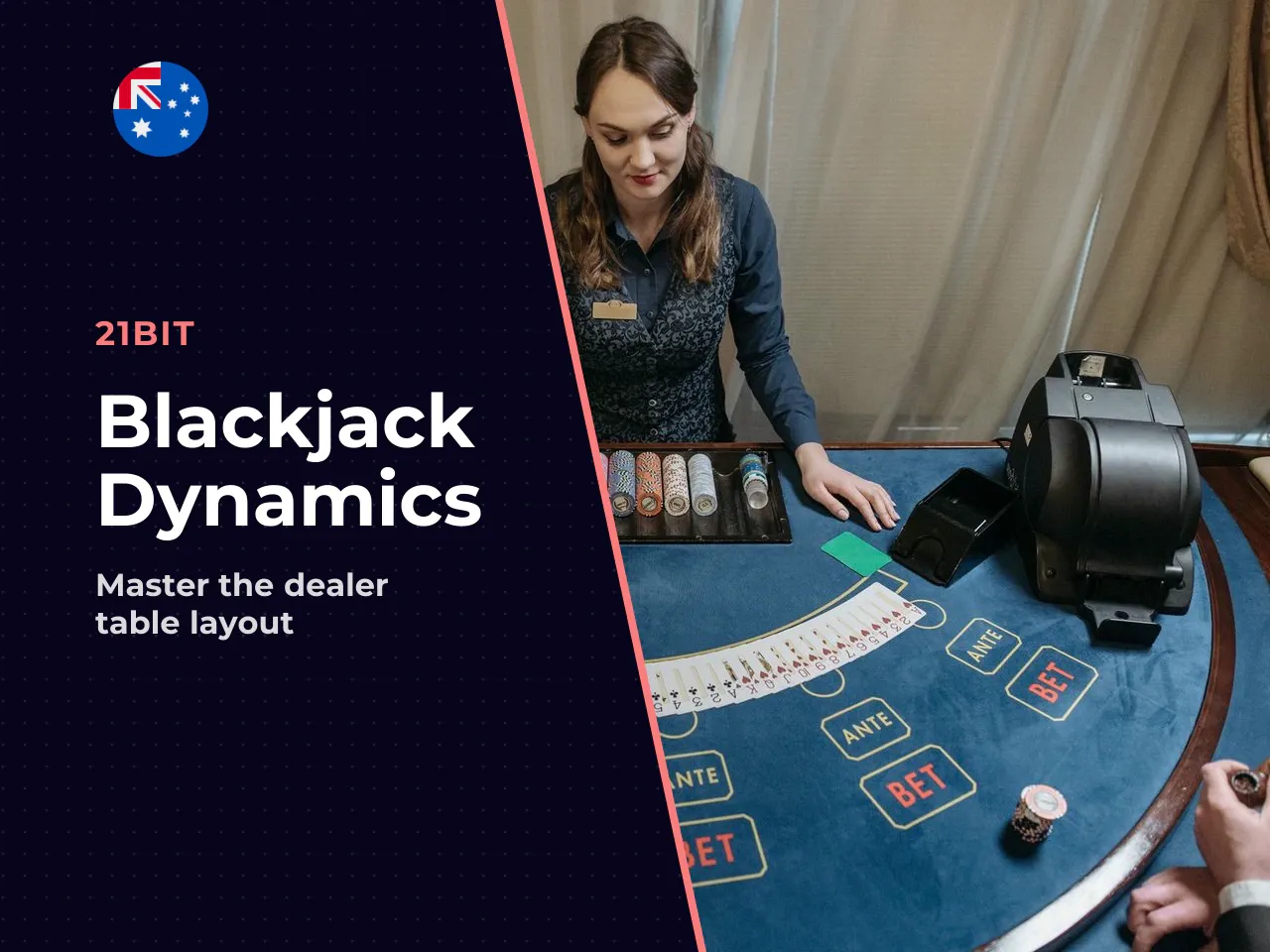
A blackjack table has designated betting spots for players and a central position for the dealer blackjack operator representing the casino. Depending on layout, one to seven blackjack players take part in the same round, each holding an independent hand dealt from a shared shoe of one to eight standard 52-card decks.

The order of play follows a strict sequence:

  1. Player phase: every player receives two initial cards and makes sequential decisions (hit, stand, double, split) before the dealer acts.
  2. Dealer phase: once all hands are complete or busted, the dealer reveals the hidden hole card and draws according to mandatory house rules.
  3. Settlement: the dealer must draw to a minimum of 17, then stands. If the dealer busts, every surviving hand wins. Otherwise the higher total wins, the lower total loses, and identical totals push.

Card Values and Strategic Roles in Classic Blackjack

Card typeExamplesPoints valueStrategic role in the hand
Number cards2, 3, 4, 5, 6, 7, 8, 9, 10Face value (2 to 10 points)Forms the core total of the hand. Low cards (2 to 6) in the dealer's visible hand signal a higher dealer bust probability.
Face cardsJack, Queen, King10 pointsPushes totals quickly toward 21, and pairs with an Ace to form a natural blackjack paying 3:2.
AceAce of any suit1 or 11 points (flexible)Provides soft hand flexibility, lowers immediate bust risk and opens aggressive double down spots.
Core Blackjack Rules and Step-by-Step Gameplay

Core Blackjack Rules and Step-by-Step Gameplay

A round of playing blackjack follows a clear seven-stage procedure, from the first bet to settlement. Before any cards appear, players place their bets inside the posted table limits. Once bets are confirmed, two cards go to each participant, with the dealer taking one face-up card and one face-down card in traditional hole-card formats.

Players then act one by one, weighing their total against the dealer's visible upcard. The house rules give the dealer no discretion at all: hit on 16 or lower, stand on 17 or higher, with minor variations around soft 17. And here is where the mathematical house edge actually comes from. Players act first, so a busted player hand loses immediately, even if the dealer busts moments later in the same round.

Player Decision Engine Hit, Stand, Double

Player Decision Engine: Hit, Stand, Double Down and Split

After the opening two cards, a player picks from four tactical options depending on hand strength and table conditions:
  • Hit:take another card to build the total. You may hit repeatedly until you stand or pass 21.
  • Stand:decline further cards and lock in your total, passing the action along.
  • Double Down:double the original wager in exchange for exactly one more card, after which the turn ends. Most rule sets restrict this to the first two cards, and it usually applies on 9, 10 or 11 against a weak dealer upcard.
  • Split:divide two cards of equal rank, such as 8-8 or Ace-Ace, into two hands by adding a wager equal to the original bet. Each hand plays independently, and many tables also allow doubling after a split (DAS).
Betting Mechanics, Table Limits and Side

Betting Mechanics, Table Limits and Side Bet Options

Table limits set the minimum and maximum betting amounts per hand, which lets very different bankrolls coexist: low-stakes RNG tables from around AU$1 per hand, high-roller VIP rooms where live limits reach AU$10,000. Beyond the main wager, specific variants add optional side bets and auxiliary rules that reshape payouts and volatility.

Common secondary options include:

  • Insurance: a side wager of up to half the main bet, offered when the dealer's upcard is an Ace. It pays 2:1 if the dealer holds a natural, yet it carries a high house edge and basic strategy tells you to leave it alone.
  • Surrender: available on the first two cards, letting you forfeit the hand and recover 50% of the original wager.
  • Side bets (Perfect Pairs, 21+3, Lucky Ladies): independent bets on specific combinations, such as matched suits or a poker hand made from your cards plus the dealer's upcard. Availability, minimums and maximums come from each operator and each software supplier, not from any universal standard.
Specific Blackjack Variant Rule Modifications. Standard

Specific Blackjack Variant Rule Modifications

Standard rules apply across most lobbies, but regional and digital variants change the mechanics, and with them both the house edge and the correct play:
  • Blackjack Surrender:lets you forfeit 50% of the initial wager straight after the deal when a weak two-card hand meets a strong upcard, for example hard 16 against a dealer Ace. Late surrender allows this only after the dealer has checked for a natural.
  • Blackjack Switch:you must play two hands at equal stakes and may swap the second card dealt to each. To offset that advantage, naturals pay 1:1 instead of 3:2, and a dealer total of 22 pushes against all non-busted hands.
  • Double Exposure Blackjack:both dealer cards are dealt face-up. In return for full information, the house wins all ties except on naturals, and blackjacks pay even money.
  • European Blackjack:the dealer takes no hole card until everyone has acted, so a doubled or split wager can be lost outright to a late dealer blackjack. Correct play turns slightly more conservative when doubling against a 10 or Ace.
  • Atlantic City Blackjack:eight decks, dealer stands on soft 17, late surrender permitted, doubling after splitting allowed. One of the friendlier published rule sets.
  • Single Deck and Multihand Blackjack:single-deck games reduce the shoe's composition edge, yet often pay 6:5 on a natural instead of 3:2. Multihand titles let you play three to five hands against one dealer upcard, which multiplies variance rather than expectation.
  • Perfect Pairs / Perfect Blackjack:adds a side wager on the first two cards forming a mixed, coloured or perfectly suited pair, with escalating payouts and a much higher house edge than the base game.

Blackjack Strategy for Beginners: Mathematical Decision Making

A mathematically sound blackjack strategy is the most effective way to shrink the house edge and avoid expensive tactical errors. Basic strategy charts use probability matrices built on your hand total versus the dealer's visible upcard, and they name the decision with the highest long-term expected value. Readers who want to rehearse those decisions with no money at stake can compare blackjack casino platforms that publish demo access on every variant.

Core Basic Strategy Matrix Rules. The

Core Basic Strategy Matrix Rules

The essential rules of basic strategy break down by hand category:

  • Hard totals:

    • Hard 8 or lower: always Hit.
    • Hard 9: Double Down against dealer 3 through 6, otherwise Hit.
    • Hard 10 or 11: Double Down against dealer 2 through 9, with 11 doubling against everything except an Ace, otherwise Hit.
    • Hard 12 to 16: Stand against 2 through 6 (weak upcards), Hit against 7 through Ace (strong upcards).
    • Hard 17 or higher: always Stand.
  • Soft totals (Ace counted as 11):

    • Soft 13 to 17: Hit against strong upcards, double against weak cards (4 to 6).
    • Soft 18: Stand against 2, 7 or 8, Double Down against 3 through 6, Hit against 9, 10 or Ace.
    • Soft 19 or higher: always Stand.
  • Pairs (splitting decisions):

    • Aces and 8s: always Split. Splitting 8s escapes a miserable hard 16, and splitting Aces creates two strong starting hands.
    • 10s, 5s and 4s: never split 10s (keep the 20) or 5s (treat as hard 10 for doubling).
    • 2s, 3s, 7s: Split against upcards 2 through 7.

Basic Strategy Matrix. Multi-deck shoe, dealer stands on soft 17, doubling after split allowed. H = Hit, S = Stand, D = Double if allowed otherwise Hit, SP = Split, SU = Surrender.

Your hand2345678910A
Hard 8 or lessHHHHHHHHHH
Hard 9HDDDDHHHHH
Hard 10DDDDDDDDHH
Hard 11DDDDDDDDDH
Hard 12S*S*SSSHHHHH
Hard 13 to 14SSSSSHHHHH
Hard 15SSSSSHHHSU/HH
Hard 16SSSSSHHSU/HSU/HSU/H
Hard 17+SSSSSSSSSS
Soft 13 to 14 (A,2 / A,3)HHHDDHHHHH
Soft 15 to 16 (A,4 / A,5)HHDDDHHHHH
Soft 17 (A,6)HDDDDHHHHH
Soft 18 (A,7)SDDDDSSHHH
Soft 19+ (A,8 / A,9)SSSSSSSSSS
A,A / 8,8SPSPSPSPSPSPSPSPSPSP
9,9SPSPSPSPSPSSPSPSS
7,7SPSPSPSPSPSPHHHH
6,6SPSPSPSPSPHHHHH
5,5DDDDDDDDHH
4,4HHHSPSPHHHHH
3,3 / 2,2SPSPSPSPSPSPHHHH
10,10SSSSSSSSSS
Strict multi-deck charts hit hard 12

* Strict multi-deck charts hit hard 12 against a dealer 2 or 3. The simplified "stand on 12 to 16 versus 2 to 6" rule costs a fraction of a percent in expected value, though it is far easier to execute at live speed.

[FLOWCHART PLACEHOLDER: Basic Strategy Decision Flowchart. Caption: "Basic Strategy Logic Flow for Hard and Soft Hands versus Dealer Upcard." Style: monochromatic technical flowchart. Purpose: visually guide the choice between Hit, Stand, Double Down and Split based on card totals. Semantics: figure containing an accessible flowchart with a complete structured text alternative in the DOM.]

Card Counting The Hi-Lo System and

Card Counting: The Hi-Lo System and Its Online Limitations

Card counting tracks whether the un-dealt cards left in a blackjack shoe skew high (10s, face cards, Aces) or low (2s through 6s). Under the Hi-Lo count, cards 2 to 6 add +1 to the running count, 7 to 9 are neutral, and 10s through Aces subtract 1. A positive true count marks a deck rich in high cards, which favours the player and mathematically justifies bigger bets and bolder doubling.

Note on online limitations: counting simply does not work in RNG online blackjack, because the software reshuffles the virtual shoe after every round and resets the composition. In live blackjack, shoes are shuffled manually or by automatic shufflers around the 50% penetration mark, so sustained counting is not viable either. Treat it as historical context and arithmetic training, not an income plan.

Common Tactical Errors and Pitfalls to Avoid

Inexperienced players tend to make emotional decisions, and every one of them widens the house edge. This matters most for younger players, who meet gambling-style mechanics long before their first real wager.

«In 2020, 26% of Australians aged 12 to 17 had played social casino games and 31.7% had played games with gambling elements.» House of Representatives Standing Committee on Social Policy and Legal Affairs, You win some, you lose more, Chapter 6 (June 2023). https://www.aph.gov.au

Mistakes worth avoiding 1. Taking insurance

Mistakes worth avoiding:

  1. Taking insurance bets. Paying for insurance against a dealer Ace carries an average house edge above 7%, so it loses money over time.
  2. Splitting pairs of 10s. Breaking a winning 20 into two speculative hands adds risk for no reason.
  3. Trusting gut feeling. Hitting hard 15 against a dealer 5, or standing on hard 12 against a dealer 10, ignores the probabilities.
  4. Chasing losses. Ramping up bet sizes to recover a balance quickly is how bankroll management collapses.
  5. Playing high-variance side bets every hand. Perfect Pairs and 21+3 wagers carry house edges many times the base game and drain a balance faster than the hands themselves.
  6. Ignoring the posted rule set. A 6:5 natural payout, or a dealer who hits soft 17, moves both the house edge and several chart decisions.
  7. Mixing bonus play with table play blindly. Breaching a bonus maximum bet clause can void winnings entirely, however good your strategy was.

Online Blackjack Formats: Demo, Real Money and Live Dealer

Blackjack online arrives in three operational formats: RNG demo modes, RNG real money blackjack, and blackjack live dealer tables streamed from professional studios. Each serves a different purpose, from risk-free mechanic testing through to high-immersion play with a human dealer.

Updated: the previous edition of this section cited undated participation data without figures or a source link. The most current jurisdictional evidence is below.

«Online casino participation increased in NSW between 2019 and 2024, while EGMs, scratch tickets and casino table games all declined.» NSW Gambling Survey 2024, Central Queensland University for the NSW Responsible Gambling Fund. https://www.aifs.gov.au/agrc

Real-money online casino services supplied to Australians are prohibited under the Interactive Gambling Act 2001 (IGA), enforced by the Australian Communications and Media Authority. Even so, adult research traffic keeps circling the same comparisons: RNG algorithms, live studio quality and licensing transparency.

«ACMA's 2024 to 2025 compliance priorities target unlicensed offshore gambling providers and emerging payment methods, including cryptocurrency.» ACMA, Compliance Priorities 2024-25. https://www.acma.gov.au

Free Demo Blackjack Technical Execution and

Free Demo Blackjack: Technical Execution and Mechanics

Blackjack demo modes run on virtual credits, so you can explore the interface, practise decisions and learn hit or stand timing without spending anything. Blackjack games for free use the same underlying Random Number Generator engine as real-money virtual titles, which makes them genuinely useful for rules comprehension. You can rehearse hit, stand, split and double down sequences, then watch how the software resolves each total.

However, longitudinal research collated by the Australian Institute of Family Studies shows that exposure to simulated gambling and demo environments can normalise casino mechanics.

«Adolescents aged 16 to 17 who played simulated gambling games were around 40 percentage points more likely to gamble with money at ages 18 to 19.» Australian Gambling Research Centre, drawing on the Growing Up in Australia longitudinal study, submission on Guidelines for the Classification of Computer Games (2023). https://www.aifs.gov.au/agrc

Complementary survey work by Russell and colleagues (2023), based on 1,026 Australian residents, also linked simulated gambling engagement with higher Problem Gambling Severity Index scores.

«A review of 67 studies found reliable evidence linking simulated gambling with problem gambling, financial harm and psychological distress.» Australian Gambling Research Centre, submission on Guidelines for the Classification of Computer Games (2023). https://www.aifs.gov.au/agrc

So treat demo play as a technical learning interface. Not risk-free entertainment.

Disclaimer: demo modes reproduce the mechanics of real-money gambling products. The information in this section is general in nature and does not replace advice from a responsible gambling specialist.

Real Money Blackjack Bankroll and Account

Real Money Blackjack: Bankroll and Account Execution

Real money blackjack stakes cash held in a verified casino account, where every hand moves your balance. RNG money blackjack resolves hands automatically through certified algorithms, giving fast hand speeds, flexible table limits and immediate settlement.

Structured bankroll management and careful payment selection matter more here than any clever chart reading. Before real stakes begin, you will meet deposit thresholds, account verification (KYC) and withdrawal processing timelines. A practical benchmark from bankroll literature: keep any single hand to 1% to 2% of the total bankroll, then choose a table whose minimum bet fits inside that ceiling, rather than stretching the ceiling to fit the table.

Blackjack Live Dealer HD Streaming, Bet

Blackjack Live Dealer: HD Streaming, Bet Behind and Features

Blackjack live dealer games sit between digital interfaces and physical venues, streaming real dealers handling real cards in real time. High-definition video, optical character recognition (OCR) tracking and live chat build an authentic blackjack live casino experience on desktop or mobile.

Unlike automated RNG software, live dealer blackjack keeps physical dealing speeds, conversation with the dealer and other seated players, and visible shoe shuffling. Table limits in live studios tend to be higher because studios cost money to run, yet you gain full visibility over card distribution and outcomes.

Modern live interfaces translate physical card draws into digital table data instantly. Beyond the classic seven-seat layout, leading studios, including Evolution Gaming, Pragmatic Play, Winfinity, OnAir, LiveVegas and Iconic 21, offer distinct features:

21Bit heading-banner
  • Bet Behind mechanics:an unlimited number of waiting players can wager on the hands of seated players. The betting player hands all tactical choices to the seat holder while keeping identical payout ratios. Evolution's flagship Blackjack Live table, released in 2015 with a published RTP of 99.28%, pairs seven seats with unlimited Bet Behind spots.
  • Scalable unlimited seats:titles such as Infinite Blackjack and ONE Blackjack deal one community two-card starting hand to thousands of simultaneous players, each then playing it to their own strategy.
  • Early decision queuing:you can pre-select hit, stand or split before your turn arrives, which speeds up hand execution by up to roughly 20% compared with land-based dealing.
  • Specialty table formats:VIP, Speed, Golden, Gravity and Grand Bonus tables layer on different limits, side bets and multiplier mechanics. VIP and private tables commonly extend maximum stakes to AU$10,000 per hand.
  • Six Card Charlie:several software and live variants award the hand automatically to any player who reaches six cards without busting.

Next to regulated live tables sits a free product category worth naming clearly.

«Social casinos are free online games that replicate blackjack and roulette without real-money payouts, and are widely accessible via social media and app stores.» ACMA, Market Snapshot: Social Casinos (2023-24). https://www.acma.gov.au

Comparative Analysis of Online Blackjack Formats

FeatureBlackjack demo (free play)RNG real money blackjackBlackjack live dealer
Real-money stakesNo, virtual credits onlyYes, debited from accountYes, debited from account
Dealer formatSoftware animation (RNG)Software algorithm (RNG)Real human dealer via live video
Game paceFast, player-controlledVery fast, instant dealModerate, real dealing time
Typical stake rangeVirtual onlyAU$1 to AU$1,000 per handAU$5 to AU$10,000 per hand (VIP)
Bonus wagering accessNot applicableOften reduced (0% to 10% weighting)Very low or excluded (0% to 5%)
Social and interactive featuresNoneNoneLive chat with dealer and players, Bet Behind

To read the table in plain terms: demo removes financial risk but also removes real payouts, RNG play maximises hand volume and minimum-bet flexibility, and live tables trade speed for transparency and a higher stake floor. Once you have compared the three, the next practical step is choosing an online casino whose lobby, limits and payout profile suit the format you intend to play.

Top High-RTP Online Blackjack Variants Available in 2026

Variant choice moves your long-run margin. The comparison below lists the best blackjack titles by certified Return to Player specification across software and live studios. RTP figures are supplier-published values and can differ between jurisdictions and rule configurations, so confirm the number inside the game's own information panel before wagering.

Top Online Blackjack Games by RTP, Provider and Rules Mechanics

Game titleSoftware providerPublished RTPKey rules featureOptimal strategy adjustment
Blackjack Lucky SevensEvoplay99.70%Bonus payouts on 7-7-7 combinationsHold standard basic strategy, and avoid over-wagering on the bonus panel.
21 Burn BlackjackBetsoft / Nucleus Gaming99.50%Option to burn the second dealt card for an unknown replacementBurn hard 15 or 16 when the dealer upcard is 7 or higher.
Royal Private Blackjack 5Winfinity / LiveVegas99.30%VIP single-seat focus with limits up to AU$10,000Follow strict basic strategy, and use the full decision timer on borderline hands.
Infinite BlackjackEvolution Gaming99.28%Unlimited seats plus Bet Behind and Six Card CharliePlay the community hand independently, and skip the four optional side bets.
Multihand BlackjackBGaming99.23%Three to five hands against one dealer upcardCut each hand's stake to about 0.5% of bankroll to manage variance.
Blackjack Live (7 seats)Evolution Gaming99.28%24/7 stream, AU$5 minimum, AU$2,000 maximum, unlimited Bet BehindUse Bet Behind only on seats you have watched following basic strategy.
Is Online Blackjack Legal in Australia

Australian readers ask two related questions: is it legal for me to play, and what happens to my money on an offshore site. Short answers below.

  • The prohibition targets suppliers, not players. Under the Interactive Gambling Act 2001, providing real-money interactive casino services, including online blackjack, to customers physically in Australia is an offence. Penalties apply to operators, and in practice ACMA pursues site blocking and formal warnings rather than individuals.
  • No Australian licence exists for online casino table games. State and territory regulators licence land-based casinos, lotteries and online wagering on sport and racing, but not online casino blackjack. Any site offering it to Australians does so from offshore, typically under a Curaçao or Anjouan licence.
  • Offshore licensing is not a consumer guarantee. Those licences add a basic layer of oversight, yet they do not promise prompt payment or fair dispute resolution. Check that the licence number, operator name and registered company in the terms match the regulator's public register, and that the licence is still active.
  • Payment friction is the most common practical risk. Credit cards are banned as a funding method for online gambling in Australia following 2023 amendments to the IGA, banks routinely decline card transactions to offshore gambling merchants, and ACMA's current priorities explicitly cover emerging payment channels such as crypto.
  • Escalation options are limited. If an offshore operator freezes a balance, your realistic avenues are the internal complaints process, the licensing authority and any independent dispute resolution body named in the terms. Not an Australian regulator.

Selecting a Casino Platform and Evaluating Offers

Choosing a blackjack casino means weighing regulatory credentials, payout reliability, game variety and promotional wagering terms. Headline banners often hide the restrictions that decide whether an offer is worth anything, which is why terms inspection belongs before registration, not after your first deposit.

Bonus Evaluation Wagering Weighting and Fine

Bonus Evaluation: Wagering Weighting and Fine Print

Casino bonuses, welcome bonus packages and deposit match offers all sit under terms and conditions that determine their real financial value for table game players. The critical figure in any welcome offer is the game contribution percentage, the wagering weighting applied to blackjack.

Online slots usually contribute 100% toward a wagering requirement, say a 30x bonus turnover. Blackjack games often contribute far less, typically between 0% and 10%, and in some operator tables up to 20%, because the house edge on classic card games is so thin. Take a $100 bonus with a 30x rollover and a 10% blackjack weighting: every $10 wagered on blackjack counts only $1 toward the $3,000 turnover requirement, which multiplies your real betting volume tenfold.

There is no universal cross-market standard here. Weighting comes from the operator's own terms and its licensing jurisdiction, so read the contribution table for every single offer.

Online Blackjack Bonus Rollover Estimator

Use the formula below to estimate the total wagering turnover required before funds become eligible for withdrawal:

Total required turnover = (Deposit + Bonus) × Rollover multiplier ÷ Blackjack contribution weighting

DepositBonus match (100%)Stated rolloverBlackjack weightingEffective required turnover
$50$5030x100% (slots baseline)$3,000
$50$5030x10% (standard blackjack rate)$30,000
$100$10035x5% (reduced blackjack rate)$140,000
Takeaway a 5 weighting demands 20

Takeaway: a 5% weighting demands 20 times more betting volume than a slot contributing 100% for exactly the same promotional credit.

Who should skip the welcome bonus entirely?

  • Players who intend to play blackjack exclusively, since a 5% to 10% contribution rate makes most slots-oriented packages mathematically unclearable inside the expiry window.
  • Players who prefer live dealer tables, which are frequently excluded from wagering altogether.
  • Anyone whose planned stake exceeds the bonus maximum bet clause, commonly AU$5 to AU$10 per hand, because breaching it can void the whole balance.
  • Players who value withdrawal flexibility over promotional credit. Decline the bonus and every dollar stays unencumbered.
  • On the other hand, cashback offers, such as 15% to 25% daily or live casino cashback, usually suit blackjack players better, because they are calculated on net losses instead of turnover multiples.
Banking Infrastructures, Payout Speeds and Verification

Banking Infrastructures, Payout Speeds and Verification

Reliable online casinos publish transparent banking details: secure deposit options and clear withdrawal timelines. Common payment methods include debit cards, e-wallets, bank transfers, prepaid vouchers and digital assets, each with its own processing parameters and identity checks.

Banking criteria worth checking before funding an account:

  • Payout speed:processing times for withdrawal requests, from instant e-wallet or crypto payouts to 3 to 5 business days for standard bank transfers.
  • Verification (KYC):mandatory Know Your Customer checks on identity and address before a first withdrawal is authorised.
  • Transaction limits and fees:minimum deposit floors, weekly or monthly cashout caps, and any currency conversion charges.
  • Method symmetry:whether the deposit method can also receive withdrawals. Vouchers and cards frequently cannot, which forces a slower bank transfer payout.

Australian-Facing Payment Methods for Online Blackjack: Speed, Limits and Practical Notes

MethodDeposit speedTypical withdrawal timeTypical limits (AUD)Notes and friction points
PayID / Osko (NPP)Instant1 to 24 hours to a linked bank account$20 min deposit, $5,000 to $10,000 weekly cashout capsFastest local fiat rail. Some banks decline gambling-coded transfers, and account names must match the casino profile.
Visa / Mastercard debitInstantOften unsupported, 3 to 5 business days where offered$10 to $20 min, $2,000 to $5,000 per transactionCredit cards are banned for online gambling in Australia, and debit transactions are frequently blocked by issuers.
Neosurf / prepaid vouchersInstantWithdrawals not supported, alternative method required$10 to $1,000 per voucherUseful for capping spend by design. Retail purchase required, with no payout route back to the voucher.
Bank transfer (BECS)1 to 3 business days3 to 5 business days$50 min, higher ceilings for verified accountsSlowest option, reliable for larger sums once KYC is complete, and easiest to reconcile in statements.
E-wallets (Skrill, Neteller, ecoPayz)InstantSame day to 24 hours$10 to $20 min, $5,000+ per transactionCurrency conversion fees are common, and e-wallet deposits are excluded from some bonus offers.
Crypto (BTC, ETH, USDT, LTC)10 to 30 minutes (network confirmations)10 minutes to 2 hours in tested payouts$20 to $30 min, often no upper capFastest observed payouts, though price volatility, network fees and exchange KYC add complexity. ACMA has flagged crypto payment channels in its current compliance priorities.

Finish identity verification before your first withdrawal request rather than after a win. Unexpected verification steps are the single most common cause of delayed payouts, and they are entirely avoidable.

Technical Safety Criteria and Operator Audits

Technical Safety Criteria and Operator Audits

Judging the safety of casino sites means reviewing security standards, game certification and licensing credentials. Strong operators publish encryption protocols, RNG audit certificates from independent testing agencies such as eCOGRA or iTech Labs, and their regulatory oversight details.

Checklist for evaluating a blackjack casino platform:

  1. Licensing and regulatory transparency: confirm valid legal registration from a recognised jurisdiction, an active licence number on the regulator's register, and a named company that matches the terms and conditions.
  2. Blackjack game selection: check for classic blackjack, multi-hand variants and live tables across varied limit ranges, plus demo access so you can compare rule sets.
  3. Table game bonus weighting: inspect the bonus terms for blackjack contribution, maximum bet restrictions and expiry windows.
  4. RNG and fair play certification: look for visible audit stamps confirming tested randomness, and published RTPs inside each game's information panel.
  5. Banking security and KYC protocols: ensure TLS/SSL encryption is active, then review the documentation required for payout authorisation, including withdrawal caps.
  6. Payout test evidence: prefer operators with documented, recent real-money withdrawal tests, not just published timeframes.
  7. Responsible gambling infrastructure: confirm self-set deposit limits, timeout options, reality checks and direct links to Gambling Help Online and BetStop.

Our editorial team documents this workflow in the iGaming methodology case study, which sets out the fine-print inspection block applied before any offer is published. Contribution tables, maximum bet clauses, withdrawal caps and expiry periods are recorded first. Headline bonus amounts last.

Editorial fact check and offer verification: Our methodology requires direct inspection of official terms documents, table contribution tables, withdrawal caps and banking policies on the operator's own terms page before any review is published. Promotional claims are never assessed on headline figures alone, and every published RTP is cross-checked against the provider's game information panel.

How to Start Playing Online Blackjack: Step-by-Step

Moving from site selection to a first wager works best as a sequence. Follow it and you avoid the two classic beginner problems: operational errors at the table, and withdrawal barriers you did not see coming.

Step 1 Navigating Free Demo Play

Step 1: Navigating Free Demo Play

  1. Select a certified platform. Use an informational review portal or a certified gaming site that offers demo modes with no deposit required.
  2. Launch the demo interface. Open the RNG blackjack game in browser mode to load virtual practice credits.
  3. Practise the core controls. Work through Hit, Stand, Double Down and Split to see how the software handles different totals.
  4. Observe hand flow. Track dealer hit sequences on soft 17, and practise calculating hand values with nothing at stake.
  5. Test the chart, not your instincts. Keep the basic strategy matrix beside the table and play at least 200 demo hands without deviating, until correct decisions feel automatic.
Step 2 Transitioning to Real Money

Step 2: Transitioning to Real Money Wagering

  1. Register the account. Complete the sign-up form with details that match your official identity documents, ready for later KYC verification.
  2. Establish personal limits. Set daily, weekly or monthly deposit limits in the account dashboard before you process a payment.
  3. Fund the account. Pick a banking method, PayID, e-wallet or crypto for instance, and make a deposit that meets table requirements, opting in or out of bonuses based on the contribution analysis above.
  4. Select appropriate table limits. Open the blackjack lobby and choose a table where the minimum wager sits at no more than 1% to 2% of your starting bankroll.
  5. Place the first wager. Position your chip on the betting spot and deal.
  6. Verify early. Upload identity documents straight after your first deposit, so the first withdrawal is not stuck in a verification queue.

Fair Gaming Protocols and Responsible Gambling

Disclaimer: the information in this section is general in nature and does not replace advice from a qualified professional. Playing for real money involves financial risk. If you notice signs of gambling dependence, contact the National Gambling Helpline on 1800 858 858.

Responsible gambling principles matter in real money blackjack. Strategy reduces the house edge, yet blackjack remains a game of chance where outcomes cannot be guaranteed and financial risk never disappears. Treat gambling as entertainment you pay for. Never as income.

Research from the National Gambling Prevalence Study Pilot 2024 confirms that more than 65% of Australian adults gamble in some form each year. Updated: the previous edition described the associated harm figure without a number or source.

«46% of Australians who gambled were classified as at some risk of harm, including moderate and high-risk categories.» Australian Gambling Research Centre, Gambling Participation and Harm Snapshot (2023). https://www.aifs.gov.au/agrc

Firm personal boundaries are what keep recreational play from turning into financial or emotional distress.

Bankroll Management, Time Caps and Loss Limits

Effective bankroll control rests on pre-commitment and session structure. Frequency of play is itself a risk marker for this game category.

«Among people who played casino table games at least monthly, 50.1% experienced moderate or high risk of gambling harm.» NSW Gambling Survey 2024, Casino Table Games Topic Summary, Central Queensland University. https://www.aifs.gov.au/agrc

Set clear operational limits before the first wager:

21Bit heading-banner
  • Deposit limits:binding daily, weekly or monthly caps configured inside the account software.
  • Session time caps:fixed playing windows, 45 minutes for example, supported by automated reality-check pop-ups. Systematic reviews of harm-minimisation tools suggest mandatory pre-commitment limits and reality checks can reduce gambling intensity, although effectiveness depends on design and compliance.
  • Stop-loss limits:a maximum loss threshold per session. Once it is reached, you leave the table. No exceptions.
  • Fixed stake sizing:individual hands restricted to 1% to 2% of the gambling balance, so normal variance does not end the session.
  • Write the rule unambiguously:a limit only works when it fits in one plain sentence with an amount, a period and an action, leaving nothing to reinterpret mid-session.
  • Self-exclusion:when control slips, use operator timeouts and the national self-exclusion register instead of relying on willpower.
Cybersecurity Standards and Account Protection. Protecting

Cybersecurity Standards and Account Protection

Protecting your account and personal data means following a few reliable baselines. Updated: the previous edition attributed a specific instruction to a single standard. The guidance below reflects the broader, verifiable body of public authentication guidance, and should be read as general best practice rather than gambling-specific regulation.

Widely referenced public guidance, including the United States National Institute of Standards and Technology's digital identity guidelines (SP 800-63-4, published July 2025 and superseding SP 800-63-3 from 1 August 2025) and CISA's phishing-resistant multi-factor authentication guidance (2025), treats MFA as the baseline for account access, with phishing-resistant factors preferred.

Financial-sector guidance adds two complementary rules: passwords must be unique, strong and screened against known weak-password lists (US Federal Reserve, SR 21-14, 2021), and login credentials plus transaction data must be encrypted in transit and at rest, with two-factor authentication applied at login (CFTC internet banking and technology risk management guidelines).

Applied to a casino account, that means a unique password stored in a password manager, MFA enabled wherever offered, no shared devices for cashier access, and an immediate review of any login notification you did not trigger yourself.

When you read an operator's terms, check that data transmission is secured via TLS/SSL and that banking information is handled under a transparent privacy policy consistent with applicable regulatory oversight.


Responsible gambling and legal disclaimer: Real-money gambling involves significant financial risk and can lead to addiction. Gambling should be treated solely as paid entertainment, never as a source of income or a way to recover debt. Never wager money you cannot afford to lose. If gambling is affecting your personal life, relationships or finances, free and confidential support is available 24/7.

  • Australian support: call the National Gambling Helpline on 1800 858 858 or visit gamblinghelponline.org.au.
  • Self-exclusion: learn about national self-exclusion tools via betstop.gov.au.
  • International guidance: BeGambleAware and GamCare both recommend setting a money limit before you start, never chasing losses, taking scheduled breaks and stopping when play stops being enjoyable.

Online Blackjack FAQ

Appendix Blackjack Glossary and Editorial Methodology

Appendix: Blackjack Glossary and Editorial Methodology

Glossary of core terms
  • Bust:a hand total above 21, which loses immediately whatever the dealer does.
  • Natural / blackjack:an Ace plus any 10-value card on the first two cards, normally paying 3:2, or 6:5 in some single-deck games.
  • Hole card:the dealer's face-down card in traditional formats, absent until the end of the round under European rules.
  • Push:a tie between player and dealer, returning the original stake.
  • Shoe:the dealing device holding one to eight decks. Penetration describes how deep into the shoe cards are dealt before a shuffle.
  • DAS / RSA:"double after split" and "re-split Aces", liberal rules that measurably lower the house edge.
  • Six Card Charlie:an automatic win for reaching six cards without busting, available in selected variants.
  • True count:in card counting, the running count divided by the estimated decks remaining.
  • Wagering weighting:the percentage of a blackjack wager that counts toward a bonus turnover requirement.
How this guide was produced 1

How this guide was produced

  1. Game rules, card values and dealer procedures were mapped against standard published rules and supplier information panels.
  2. RTP figures, provider names, limits and payout timings were compiled from supplier documentation and hands-on operator testing across live and RNG lobbies, including PayID and crypto deposit and withdrawal cycles.
  3. Participation, harm and simulated-gambling data came from the Australian Gambling Research Centre, the NSW Gambling Survey 2024 (Central Queensland University for the NSW Responsible Gambling Fund), ACMA compliance and market publications, and the 2023 House of Representatives inquiry report You win some, you lose more.
  4. Security guidance was drawn from public authentication standards (NIST SP 800-63-4, CISA, US Federal Reserve SR 21-14, CFTC technology risk guidelines) and is presented as general best practice.
  5. Claims that could not be verified against a primary source were removed before publication rather than softened.

About the author

Claire Bennett is Senior iGaming Content Editor at sitebname, where she leads table-game coverage and offer verification. Her review workflow puts terms documents, contribution tables and completed real-money withdrawal tests ahead of marketing material, and every blackjack variant referenced in this guide was played in demo or real-money mode before publication.