Mines Game Online Mechanics, Regulation, RTP

Mines Game Online: Mechanics, Regulation, RTP and Real Risk in Australia

Last updated: 4 June 2026 · Reviewed against ACMA enforcement reporting, gaming machine standards and peer-reviewed gambling research

Mines is an online casino instant game played on a hidden grid. You set a stake, choose how many mines will be buried under the tiles, then reveal tiles one at a time. Every safe tile lifts your multiplier; one mine ends the round and forfeits the stake. There is no puzzle-solving edge and no skill component that changes the mathematics. The payout table is fixed, the outcome comes from a random number generator, and the only genuine decision you make is when to press cash out.

That last sentence is the whole game, really.

This guide covers the product in one place: how the grid mathematics actually work, the exact specifications of the three major versions (Spribe, Hacksaw Gaming and Stake Originals), how Provably Fair verification is performed, what betting systems such as Martingale, Paroli and "10 Bets" do and do not achieve, how mobile access works through browsers, PWAs and APK files, and, critically for Australian readers, where Mines sits inside the Interactive Gambling Act 2001 and current ACMA enforcement activity.

Responsible gambling notice. This article is informational and analytical. It does not promote gambling, does not claim any method of guaranteeing wins, and does not endorse illegal services. Gambling involves a real risk of losing money. If gambling is causing you or someone you know harm, the National Gambling Helpline is available 24/7 on 1800 858 858.

Key takeaways. - Mines is a

Key takeaways

  • Mines is a casino instant game, not a puzzle. Mine positions are hidden and randomly generated, so no deductive logic applies.
  • Published RTP for Mines-style games ranges roughly from 94% to 99% depending on the provider and configuration. There is no single universal figure.
  • Increasing the mine count raises volatility and the per-pick multiplier, but under recognised gaming machine standards it is not permitted to materially change the theoretical return.
  • No betting system, whether Martingale, Paroli, Fibonacci, D'Alembert or "10 Bets", can convert a negative expected value into a positive one.
  • Real-money Mines offered to Australians by offshore operators is generally a prohibited interactive gambling service, and ACMA has been blocking such sites at scale.

What Mines Game Is and How the Game Works

Mines casino game and its relation

Mines casino game and its relation to classic minesweeper

Mines borrows its visual grammar from the Windows puzzle Minesweeper, but the two are structurally different products. In Minesweeper, the mine positions are fixed at the start and the surrounding numeric clues let a competent player deduce, with certainty in many board states, which cells are safe. Skill is the primary determinant of the outcome, and no money is at stake.

In the casino version, the numeric clues are removed entirely. The player stakes money before the round begins; the game engine then randomly distributes mines across the grid using a certified random number generator (RNG). Because no clue layer exists, there is no information from which to deduce a safe cell, and every pick is a wager rather than an inference.

Regulatory guidance on randomness supports this framing: gaming regulators define a compliant RNG as one producing outcomes with no predictable pattern, and they require independent testing of the generation method. That requirement is precisely what removes any deductive advantage from the casino format.

«Randomness requires that outcomes exhibit no predictable pattern and that generation methods be independently tested.» — Australian/New Zealand Gaming Machine National Standard, RNG requirements (regulator guidance summarised in source [7]).

So Mines only superficially resembles a

So Mines only superficially resembles a logic game. Functionally it belongs to the same family as crash and instant-win titles: Aviator, Limbo, Plinko, Dice. Rounds resolve in seconds, feedback is immediate, and the player's sole lever is the timing of a cash-out decision. Spribe, one of the format's principal suppliers, lists Mines within its Instant Games portfolio alongside Aviator and Limbo rather than among slots, which is an accurate reflection of how the product behaves. Because these games combine rapid round cycles, player-selected volatility and continuous monetary staking, they fall squarely into the higher-risk category of online casino games that longitudinal research links to at-risk gambling and gaming [8].

«Online casino games are associated with the highest likelihood of problem gambling and gaming among the formats studied.» — Colliding harms of gambling and gaming, peer-reviewed longitudinal study (2024), source [8].

The grid, mines and safe cells

The grid, mines and safe cells: risk structure within a round

The canonical layout is a 5×5 grid of 25 tiles. Before the round starts, the player selects a mine count M; the remaining 25 − M tiles conceal gems. Each successful pick raises the multiplier and shrinks the pool of remaining safe tiles, so conditional risk climbs with every additional reveal.

The probability of surviving k consecutive picks on a grid of N tiles containing M mines is:

P(k) = C(N − M, k) / C(N, k)

which expands to the product form:

P(k) = ∏(i = 0 → k−1) (N − M − i) / (N − i)

The multiplier offered for the k-th safe pick is then approximately RTP ÷ P(k). That single relationship explains the entire economics of the game: the paytable is a mechanical inversion of survival probability, discounted by the house edge. It also explains why mine count changes the shape of the risk without changing the cost of play. A 5×5 grid with three mines produces small, frequent increments. The same grid with 20 mines produces a first-pick multiplier above 4x but destroys most rounds immediately.

Worked probabilities on a 25-tile grid at 97% RTP:

MinesSafe picksSurvival probabilityIndicative multiplier
1196.00%1.01x
3188.00%1.10x
3549.60%1.96x
5358.70%1.65x
8245.33%2.14x
13148.00%2.02x
20120.00%4.85x
2414.00%24.25x

This is exactly the design logic that gaming machine standards anticipate when they let players select between option sets within a single game configuration. Recognised standards constrain how far those options may shift the theoretical return, closely mirroring the design of Mines: mine count is permitted to alter volatility but not the underlying RTP.

«Changing bet options within a single game configuration must not alter the theoretical RTP by more than 0.20 percentage points.» — Australian/New Zealand Gaming Machine National Standard, clause 4.17, source [7].

The practical reading for players is blunt. Choosing 20 mines instead of three does not make the game "better value" or "worse value". It makes outcomes more extreme in both directions while the long-run cost of each dollar wagered stays effectively constant.

Varieties of Mines: comparing providers

Different studios publish different Mines builds, and the specifications diverge enough that quoting a single RTP for "Mines" is misleading. The table below consolidates the three implementations most Australian readers meet in search results.

ParameterSpribe MinesHacksaw Gaming MinesStake Originals Mines
Grid size5×5Configurable, 3×3 to 9×95×5
Mine count1 – 201 – 801 – 24
Published RTP~97.00%94.00% – 96.00%~99.00%
Max multiplierup to x10,000up to x10,000up to x2,000,000
Fairness modelCertified RNG, provably fair optionsCertified RNGCustom provably fair (server/client seed + nonce)
Distinguishing featuresFast rounds, autoplay, one-tap cash-outVariable grid dimensions, extreme mine ceilingsVery low house edge, in-house verification tooling
Two corrections matter here, because both

Two corrections matter here, because both circulate widely as misinformation:

  • "The RTP for Mines is 94%" applies specifically to the Hacksaw Gaming title, where it is stated in the game's own help file. It is not a universal figure. Spribe's implementation is documented at approximately 97%, and Stake's original build is advertised near 99%. Always read the RTP from the in-game information panel of the exact build you are playing.
  • "Set the grid size (3×3–9×9) and the number of mines (1–80)" is accurate, but only for Hacksaw. Neither Spribe nor Stake Originals allows grid resizing; both are locked to 25 tiles.

How to Play Mines Online: Step-by-Step Order of Actions

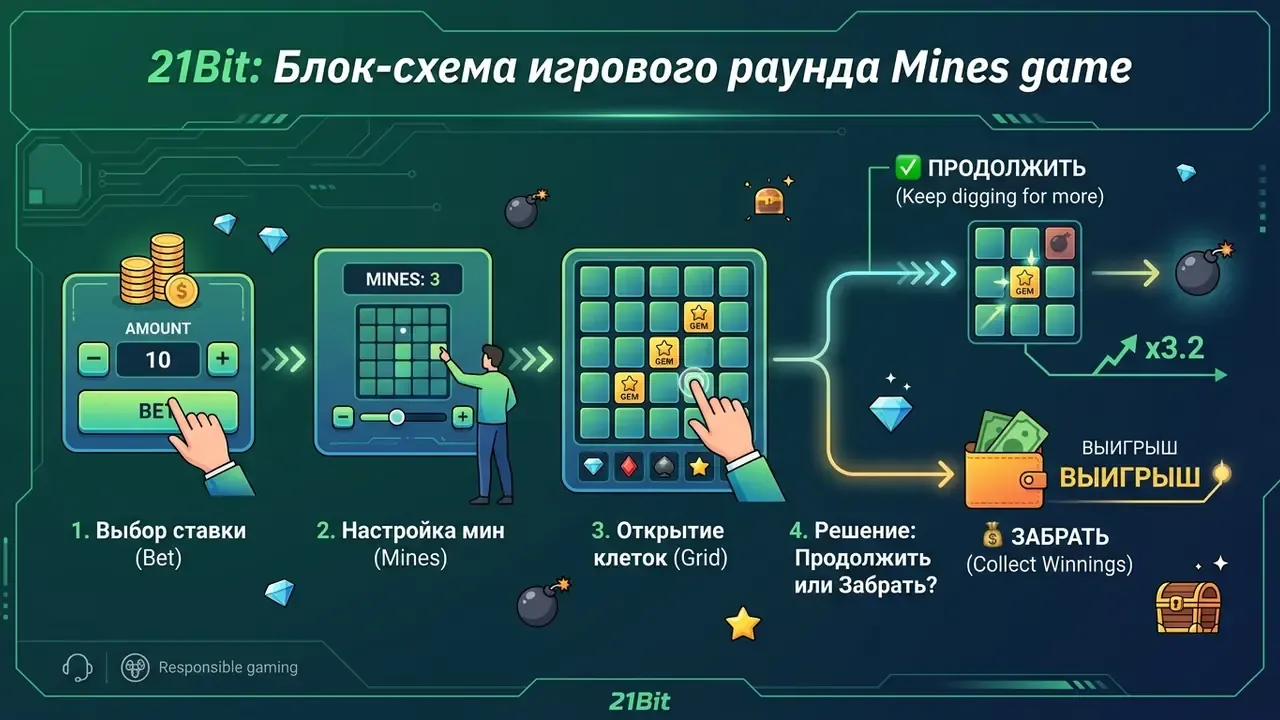
Every commercial Mines build follows the same loop. Reconstructed as a decision sequence:
1
Set the stake. Choose the amount at risk for the round. This is the only figure that can be lost, and it is lost in full on a mine hit.
2
Set the mine count (and grid size, where offered). This fixes the paytable for the round. Higher mine counts front-load the multiplier growth.
3
Reveal tiles one at a time. A gem increases the accrued win and grants another pick. A mine ends the round immediately and forfeits everything accrued.
4
Decide: cash out or continue. After any gem, cash out to bank the current multiplier, or continue and accept a higher conditional probability of loss on the next pick.
5
Round closes. The result is written to the game history. Provably fair builds publish the unhashed server seed at this point, so the layout can be checked independently.

Autoplay features, present in Spribe and Stake builds, automate steps 3 and 4 by pre-committing a pick pattern, a round count and optional stop-on-win or stop-on-loss thresholds. Autoplay does not change probabilities. It changes speed, which is a materially different risk factor, discussed below.

Choosing the bet and mine count

Choosing the bet and mine count before the round

Two settings define the round before a single tile is touched. The bet size decides your exposure; the mine count decides the paytable and the hit frequency. Most builds also expose secondary options: quick-bet buttons, a bet doubler, autoplay round limits and, in Hacksaw's version, grid dimensions.

A quick sanity check that costs nothing: work out how many picks you need to reach your intended multiplier at your chosen mine count, then look up that survival probability in the table above. If three mines and five picks means a coin-flip round, you want to know that before you press the tile, not after.

When to cash out in Mines

When to cash out in Mines

There is no correct multiplier to bank at, but there is a correct process: decide before the round, then honour it. The cash-out button is the only genuine agency in the game, and it is also where most bankroll damage happens, because "one more pick" is an easy thought after a gem and a hard thought after a mine.

A useful discipline is to pre-commit two numbers, not one: the target multiplier and the number of consecutive rounds you will play at that target. Then stop and count. Players who log their intended cash-out point and compare it with what they actually did usually discover the gap is larger than they assumed.

How to verify round fairness Provably

How to verify round fairness (Provably Fair)

Provably Fair is a cryptographic commitment scheme. It guarantees that the mine layout was determined before the round began and that the operator could not have altered it in response to your picks. It does not guarantee that the game is profitable, and it does not reduce the house edge.

Verification procedure:

  1. Before the round, the operator publishes a hashed server seed, a SHA-256 digest of a secret value. Because hashing is one-way, publishing the digest commits the operator to that value without revealing it.
  2. You supply or accept a client seed. Combined with the server seed and an incrementing nonce, this determines the mine placement deterministically.
  3. After the round, the operator reveals the unhashed server seed.
  4. Run that revealed seed through any independent SHA-256 calculator and compare the output with the hash you were given beforehand. A character-for-character match proves the layout was pre-committed.
  5. Re-derive the mine positions from server seed + client seed + nonce using the operator's published algorithm, and confirm they match what the round displayed.

One widely repeated claim needs qualifying: the statement that "Mines is based on a blockchain" is imprecise. Provably Fair relies on cryptographic hashing (typically SHA-256) and seed commitment. Some crypto casinos additionally anchor seeds to a public blockchain block hash, but the gameplay itself generally runs on the operator's servers, not on-chain. Treat "provably fair" as auditable, not as decentralised and not as player-favourable.

The Interactive Gambling Act 2001 and

The Interactive Gambling Act 2001 and prohibited services

Australia's regulatory posture toward online casino games is restrictive rather than permissive. Under the Interactive Gambling Act 2001 (IGA), it is an offence to provide certain interactive gambling services to customers physically present in Australia. Online casino-style games, including instant-win grid games of the Mines type, online slots, roulette and blackjack, sit inside the prohibited category. Licensed online wagering on sport and racing, by contrast, is permitted through operators licensed by an Australian state or territory.

The prohibition is directed at the supply side. The IGA targets operators and, through the 2017 amendments, individuals in senior positions of offending companies. It does not create an offence for the individual Australian who places a bet. That asymmetry is frequently exploited in marketing copy implying offshore casino play is therefore "legal and safe". It is neither endorsed nor protected. Consumers using prohibited services have no access to Australian dispute resolution, no statutory protection of deposited funds, and no recourse if withdrawals are refused or accounts are voided.

For readers evaluating a site, the practical compliance markers are:

  • Licence verifiability. A named regulator, a licence number, and a status you can confirm in the regulator's own public register, not merely a logo in the footer.
  • Software authenticity. The Mines build should come from the studio itself or its official distributor, with matching provider branding, version identifiers and help-file RTP.
  • Payout transparency. Round rules, paytables, bet limits and settlement procedures published in full and not subject to silent amendment.
  • Verifiable RTP. A stated figure in the game information panel, consistent with the provider's published specification or test certificate.
  • KYC/AML processes. Registration, identity verification and source-of-funds checks are compliance obligations, not obstacles. Their absence is a warning sign, not a convenience.

ACMA enforcement and disruption actions 2023–2025

ACMA's enforcement record shows how actively the prohibition is applied. In its joint annual reporting with eSafety, ACMA found that 18 services, equivalent to 86%, breached interactive gambling rules.

«Of 21 services investigated, 18 (86%) breached interactive gambling rules; 15 received formal warnings after refusing to restrict access.» — ACMA and eSafety Joint Annual Report 2023–24, source [2].

Quarterly disruption activity is equally instructive. In a single quarter, ACMA referred 75 websites to ISPs for blocking and reported 75 URLs to family-friendly filter providers, many of which offer casino-style games analogous to Mines.

«Between October and December 2024, ACMA received 301 reports, of which 243 (85%) were assessed as valid complaints under the Interactive Gambling Act.» — ACMA, Action on interactive gambling: October to December 2024 (2025), source [5].

Blocking is a disruption mechanism, not an eradication mechanism. Blocked operators routinely re-emerge under mirror domains, which is why the volume of referrals stays high year on year, and why a site being reachable today is no evidence of its legality or longevity.

The regulatory implication for Mines specifically: if a site offers you real-money Mines from an Australian IP address, the overwhelming probability is that it is an offshore, unlicensed operator whose access to the Australian market ACMA is actively working to disrupt.

Market Context: Participation, Losses and Harm

Online gambling participation and internet use

Online gambling participation and internet use

Australia's exposure to gambling is exceptional by international standards. Near-universal internet penetration and near-universal smartphone ownership have made continuously available casino-style products a permanent feature of the home environment rather than a destination activity.

Participation is climbing. Recent national data indicate that more than a third, 36%, of Australian adults gambled online in some form, up from 32% in 2023 [4]. That four-point movement in a single year matters precisely because it happened without any liberalisation of online casino law. Growth is occurring in wagering, in emerging grey-market products, and in offshore casino play that regulation is meant to suppress.

The financial scale is the clearest indicator of risk concentration. Australians lose more per head on gambling than any other population, the highest losses per capita in the world at around AUD 1,521 per adult.

«In 2023–24 Australians lost more than AUD 32 billion on legal forms of gambling.» — Australian Government response to the Committee inquiry into online gambling (2026), citing Queensland Treasury, source [3].

Set against those aggregates, an individual Mines session looks trivially small: a series of one-dollar rounds. The aggregate is built entirely from such rounds, at high frequency, across millions of accounts.

Gambling harm and product-specific risk

Harm is not distributed evenly across gambling products. Structural characteristics such as event frequency, continuity of play, immediacy of feedback and in-product staking adjustment predict risk far better than the nominal category of the game.

Historically, electronic gaming machines (EGMs) showed the highest risk potential among more traditional forms of gambling, driven by rapid repeat cycles and near-continuous reinforcement. Contemporary evidence extends that finding into the online environment.

«Online casinos are associated with the highest likelihood of problem gambling; microtransactions in digital games also increase that risk over time.» — Colliding harms of gambling and gaming (2024), source [8].

Mines exhibits, in a single interface, nearly every structural risk factor identified in that literature: sub-ten-second rounds, an immediate binary outcome, player-adjustable volatility, an autoplay function that removes the natural pause between wagers, and a cash-out button that manufactures a persuasive but illusory sense of agency over a randomly generated result.

Instant-win mechanics, prize draws and analogues to Mines

Regulatory work on adjacent instant-win products offers the closest available proxy evidence for Mines-type games. The UK Competition and Markets Authority's market study of online prize draws and competitions (PDCs), products sharing instant resolution, low unit cost and high repeat frequency, recorded a markedly elevated harm profile among participants: 12% of PDC players classified as gambling with negative consequences and a possible loss of control (PGSI score 8+), compared to 5% of all gamblers and 3% of the general population.

«Among instant prize-draw participants, 12% score PGSI 8+ — double the rate among all gamblers (5%) and four times the rate in the general population (3%).» — CMA, Online prize draws and competitions market study, source [14].

Speed of play is the mechanism that turns a small statistical edge into a substantial hourly cost. Rather than quoting a single unsourced hourly figure, the honest presentation is an explicit calculation whose inputs you can vary yourself. Expected hourly loss is simply stake × rounds per hour × house edge:

ConfigurationStakeRounds/hourHouse edgeIllustrative expected loss/hour
Manual play, 97% RTP$11503%~$4.50
Autoplay, 97% RTP$13003%~$9.00
Autoplay, 94% RTP$13006%~$18.00
Autoplay, 99% RTP$13001%~$3.00
Autoplay, 97% RTP$53003%~$45.00

Review resources commonly note that at high round velocity the expected hourly cost of Mines can materially exceed that of slower crash-style formats, because round frequency compounds the effect of the house edge. The arithmetic above shows why. Nothing about the game changes, only how many times per hour the edge is applied. (The original, less precisely sourced formulation of this passage is retained in Appendix A.)

Smartphone use and long-term engagement with online gambling

Longitudinal work on the profile of online gamblers links device-level behaviour to sustained gambling engagement. A five-wave study of 2,196 participants conducted between 2020 and 2022 found that non-engagement in online gambling across all waves was significantly associated with the absence of smartphone addiction indicators, with a parameter estimate b = 2.63, standard error 0.49 and p < 0.001.

«Participants who never engaged in online gambling across five waves were significantly less likely to display smartphone addiction indicators (b = 2.63; p < 0.001).» — Exploring the Profile of Online Gamblers: Key Factors and the Role of Smartphone Addiction in Long-Term Gambling Engagement, 2,196 participants, 2020–2022, source [15].

The direction of the association matters

The direction of the association matters for a product like Mines, designed for one-handed play on a phone in short bursts. Compulsive device use and continuous-format gambling are mutually reinforcing: the phone supplies constant opportunity, and the game supplies immediate reinforcement.

ACMA and eSafety published research titled Levelling up to stay safe in February 2024, examining young people's experiences in online gaming environments. It is cited here as an administrative fact about the regulators' research programme rather than as quantitative evidence about Mines, since the published summary does not report sample-level statistics applicable to instant casino games. (The earlier, stronger formulation is preserved in Appendix A.)

Youth gaming, simulated gambling and loot boxes

The convergence of gaming and gambling aesthetics is the clearest structural risk facing younger cohorts. Online casinos and EGMs have begun adopting features from arcade games, and they are able to attract younger gamers, blurring the boundaries between entertainment and gambling.

«Online casinos and EGMs adopt arcade-game mechanics, attracting younger gamers and blurring the line between entertainment and gambling.» — Colliding harms of gambling and gaming (2024), source [8].

Mines is a textbook case. Its grid, gem icons and explosion animation come straight from a puzzle game familiar to anyone who used a Windows PC. Its risk architecture comes from casino mathematics. A user who recognises the first and does not understand the second has no accurate mental model of what they are doing. The same convergence appears in loot boxes and simulated-gambling minigames inside mainstream titles, which normalise randomised-reward staking well before the legal gambling age.

Mines Demo and Mines Free: How to Play Without Risk

Features and purpose of demo and

Features and purpose of demo and free-play modes

Demo mode runs the identical game engine on a virtual balance. The grid, mine options, paytable and RNG behaviour are the same; only the currency is notional. There is no deposit, no withdrawal, no wagering contribution and, in most implementations, no persistence of results.

Legitimate uses are narrow but real: learning the interface, watching how mine count reshapes the multiplier curve, confirming the RTP stated in the help file, and testing whether a staking discipline is one you can actually follow. Documented limitations matter just as much.

Funds cannot be deposited or withdrawn, bonuses and loyalty progress generally do not accrue, some builds cap session length or feature access, and, most consequentially, the psychological texture of play is completely different.

That last point is the substantive concern. Free play is not risk-neutral exposure. Because outcomes carry no financial consequence, demo sessions may still condition behavioural responses and risk perceptions, potentially making real-money play more appealing, especially to younger users or those with existing vulnerabilities.

«Around two-thirds of instant prize-draw participants agree such products are addictive; charities identify their role as a springboard into other forms of gambling.» — CMA, Online prize draws and competitions market study, source [14].

A further asymmetry deserves naming. A demo session that runs unusually well is remembered as evidence of competence, while the same variance in real money would be remembered as luck. Demo play therefore has a structural tendency to overstate perceived skill.

Comparing demo and real-money Mines: stakes, goals and outcomes

CriterionMines demo / free playMines real money
Financial riskNone, virtual credits onlyFull stake at risk every round
WithdrawalsNot possiblePossible, subject to KYC and operator terms
Registration requiredOften notAlways: account, KYC/AML, deposit
Bonus eligibilityGenerally noneDeposit and promotional offers apply
Psychological stateCuriosity, experimentation, low arousalLoss aversion, arousal, chasing pressure
Behavioural riskLow, but can normalise staking patternsHigh, real deposit depletion possible
Primary purposeLearning rules, testing disciplineWagering for monetary return
Consequence of a losing streakReset the balanceDepleted bankroll and potential harm
The critical difference is not mechanical

The critical difference is not mechanical, it is affective. Research into gambling arousal consistently links heightened excitement to greater risk-taking and weakened stopping behaviour. In Mines, that shows up as two observable patterns: extending picks past the point at which a player intended to cash out, and increasing stake size after a losing sequence. Neither behaviour appears in demo play, which is exactly why demo results are a poor predictor of real-money conduct.

Serial losses compound this. Because each round is independent, a losing streak carries no corrective force. It simply subtracts stake after stake while the player's tolerance for further risk erodes. That path dependence, a bankroll shrinking while risk appetite grows, is the mechanism by which deposits are exhausted faster than any single round would suggest. It is amplified on illegal offshore casino sites where deposit limits, loss caps and self-exclusion tools may be absent or unenforced, increasing the risk that repeated play leads to harm.

What is actually worth testing in

What is actually worth testing in demo mode

If you use demo mode, test parameters and behaviour rather than "systems":

  • Mine count against multiplier curve. Compare 3, 5, 8, 13 and 20 mines and record how many picks are needed to reach roughly 2x in each configuration.
  • Cash-out discipline. Pre-commit to a target multiplier and record how often you actually honour it. This is the single most transferable finding.
  • Streak length distribution. Log the longest safe run and the frequency of first-pick losses at your chosen mine count. Compare against the theoretical probability from the formula above.
  • Autoplay behaviour. Watch how many rounds elapse per minute and how quickly a notional balance moves. This is your hourly-cost reality check.
  • RTP verification. Locate the stated RTP in the help file and confirm which provider build you are actually playing.
  • Stop rules. Test a hard session length and a hard loss limit, then note whether you extended either.

Mines Real Money: Access, Account Checks and What Play Actually Costs

Disclaimer. Mines is a gambling game. Real-money play carries a genuine risk of losing funds, and access to any online casino depends on your age and on the rules that apply where you are. Online casino games are restricted or prohibited in Australia, and nothing here should be read as encouragement to deposit.

Real-money Mines sits inside an operator account, not inside the game. Before a single tile is revealed you need a registered account, completed identity verification and a funded balance. Withdrawals then depend on the operator's KYC and payment terms rather than on how well the round went. For Australian readers, the earlier legal section is the governing context: the operators offering real-money Mines to this market are, in the great majority of cases, offshore and unlicensed here.

What to look at when assessing

What to look at when assessing a Mines casino

If you are researching a brand rather than a game, the checks that actually matter are unglamorous:

  • Licence and register entry. A named regulator plus a number you can confirm independently.
  • Provider build. Which studio supplies the Mines game, and whether the help-file RTP matches that studio's published specification.
  • Bonus terms before bonus size. Wagering multiple, maximum bet while wagering, expiry window, maximum cashout, and whether instant games contribute at all. Many casinos weight instant titles at 0%, which quietly makes a bonus unusable on Mines.
  • Withdrawal rules. Processing times, minimum and maximum limits, documents requested, and whether pending periods can be reversed.
  • Payment methods. Whether the deposit route also supports withdrawal, and what fees apply.
  • Complaint history. Recurring reports about verification delays, voided wins or blocked accounts are a stronger signal than any review score.
  • Responsible gambling tools. Deposit limits, loss limits, session reminders and self-exclusion, available without contacting support.

Who should skip real-money Mines entirely? Anyone chasing losses, anyone playing with money needed for living costs, and anyone who cannot verify the licence in a public register. That is not a soft recommendation.

Real stakes, winnings and the risk

Real stakes, winnings and the risk of losing money

Every round has three inputs and one uncontrollable variable. You choose the bet, the mine count and the exit point. The engine chooses where the mines are. Winnings are the accrued multiplier at the moment you cash out, and they vanish entirely if a mine lands first.

The arithmetic is unsentimental: at 97% RTP, roughly three cents of every dollar staked is the cost of playing, applied per round, hundreds of times per hour under autoplay. A large single win does not offset that; it is simply variance around a negative mean. Treat any balance in a real-money Mines session as spent entertainment expenditure, and treat a withdrawal as a pleasant exception rather than a plan.

Mines Strategy: Settings, Systems and Their Limits

Risk disclaimer. This section is general information. Gambling carries financial risk, and no staking pattern described here can produce a long-term profit. If you need support, contact the National Gambling Helpline on 1800 858 858.

What strategy can and cannot mean

What "strategy" can and cannot mean

There is a legitimate sense in which Mines rewards structure: a pre-committed staking plan and cash-out target reduce impulsive decisions, cap session losses and make spending visible. There is no sense in which structure alters the mathematics. The paytable derives from survival probability discounted by the house edge, and that discount applies to every round independently of what came before.

So the honest framing is this: strategies in Mines are variance management and behavioural scaffolding, not profit engines. Any resource claiming otherwise is either mistaken or selling something.

Cash-out timing and expected value. Because

Cash-out timing and expected value

Because the multiplier is constructed as RTP ÷ P(k), expected value is essentially flat across cash-out points. Continuing one more pick multiplies your accrued win by a factor very close to the reciprocal of the conditional survival probability, so:
  • Early cash-out (low k):high hit frequency, small increments, low variance, slow bankroll decay.
  • Late cash-out (high k):low hit frequency, large increments, high variance, rapid bankroll swings.
  • Expected loss per dollar staked:approximately identical in both cases.

Formally, continuing is worthwhile only when the marginal expected value of the next pick exceeds the certain value of banking now, and in a fixed-paytable game that inequality is engineered to be, at best, neutral. The practical corollary: choose a cash-out point matching the volatility you can emotionally sustain, then hold it. Discipline is the real variable, not the mathematics.

Low-risk versus high-risk mine counts

ApproachMines (25-tile grid)Typical picksHit frequencyMultiplier rangeBankroll profile
Conservative1 – 31 – 4Very high1.01x – 1.30xSlow, steady decay; long sessions
Balanced4 – 82 – 4Moderate1.5x – 2.5xModerate swings; system-friendly
Aggressive10 – 151 – 2Roughly even2x – 4xSharp swings; fast depletion risk
Extreme16 – 241Low to very low4x – 24x+Lottery-like; most rounds lost

Expected loss per dollar staked is effectively constant across all four rows. What changes is time-to-ruin and emotional load. Conservative configurations lose money slowly and quietly; extreme configurations lose it quickly and dramatically. Neither is "smarter".

Evaluation of betting systems Martingale and

Evaluation of betting systems: Martingale and similar patterns

The Martingale system doubles the stake after each loss, so a single win recovers all prior losses plus one base unit. Applied to Mines, it usually pairs with a high mine count and a ~2x cash-out target, since the system needs an approximately even-money proposition.

Its failure mode is structural, not incidental. Stake requirements grow geometrically: 1, 2, 4, 8, 16, 32, 64, 128. A run of eight losses on a $1 base requires $256 for the ninth wager and a cumulative outlay of $511 to chase a $1 profit. At a ~48% win probability per round (13 mines, 2.02x target), eight consecutive losses occur roughly once in every 180 sequences. That is an ordinary evening's play, not a freak event. Statistical analysis of comparable systems finds the martingale strategy riskier than constant-stake strategies, despite the occasional short-term profit.

«The martingale system only works "safely" in a casino without table limits and with an unlimited bankroll — conditions that do not exist in reality.» — A Statistical Analysis of the Roulette Martingale System: Examples, Formulas and Simulations with R, source [16].

The same reasoning disposes of pattern-hunting. If rounds are independent, then P(Xₙ₊₁ | X₁ … Xₙ) = P(Xₙ₊₁): prior outcomes carry zero information about the next layout. Selecting tiles diagonally, in corners, or in a "lucky" sequence changes nothing except how quickly you play. No betting system can alter the fixed RTP casino games publish, or guarantee profit over time. That conclusion is supported both by gaming machine standards and by statistical analyses of comparable systems.

The Paroli progression, with a 20-round simulation

Paroli inverts Martingale: stakes increase only after wins and reset to base after any loss. This caps downside, since a losing round always costs the base unit, while attempting to exploit short winning streaks.

Structure with a three-step ladder and a ~2x cash-out target:

StepStakeOn winOn loss
1$1advance to step 2reset to step 1
2$2advance to step 3reset to step 1
3$4bank profit, reset to step 1reset to step 1

A 20-round simulation at a 2.14x target (8 mines, two safe picks; see the fact-check note below):

#StakeMultiplierResultProfit
1$12.14xWin+1.14
2$2Loss−2.00
3$1Loss−1.00
4$12.14xWin+1.14
5$22.14xWin+2.28
6$4Loss−4.00
7$1Loss−1.00
8$1Loss−1.00
9$12.14xWin+1.14
10$22.14xWin+2.28
11$42.14xWin+4.56
12$1Loss−1.00
13$12.14xWin+1.14
14$2Loss−2.00
15$12.14xWin+1.14
16$22.14xWin+2.28
17$4Loss−4.00
18$1Loss−1.00
19$12.14xWin+1.14
20$22.14xWin+2.28
Total11 W / 9 L+$1.52
A shorter five-round illustration makes the

A shorter five-round illustration makes the mechanic obvious: $1 win (+1.14) → $2 win (+2.28) → $4 loss (−4.00) → reset to $1, net +$0.58 across the sequence.

Read the result correctly. A +$1.52 return on roughly $34 wagered is a variance outcome, not evidence of edge. Paroli's genuine advantage is that losses stay bounded at the base unit. Its genuine weakness is that repeated failure at step three quietly erodes the bankroll, and the short winning streaks it depends on are rare by construction. It is a disciplined staking template, not a method of making money.

Fact-check note. Some strategy sites pair a 2.14x target with a single mine. On a 25-tile grid at 97% RTP, one mine reaching ~2.14x requires roughly 14 consecutive safe picks (survival probability 44%), not one or two. A 2.14x target is achieved in two picks with eight mines, or in one pick with thirteen mines (2.02x). Configuration and target must be quoted together, or the numbers are meaningless.

The 10 Bets system difficulty-rotation with

The "10 Bets" system: difficulty-rotation with a staking matrix

"10 Bets" is a self-balancing progression that rotates mine counts across four series of ten rounds and derives each series' stakes from the previous series' results. It requires a written table. The bookkeeping is the strategy.

Series structure and cash-out targets (25-tile grid, ~97% RTP):

  1. Series 1 — 13 mines, cash out at ~2.02x (1 safe pick). Flat $1 stakes across ten rounds.
  2. Series 2 — 8 mines, cash out at ~2.13x (2 safe picks). Stakes taken from Series 1 outcomes.
  3. Series 3 — 6 mines, cash out at ~2.30x (3 safe picks). Stakes derived from Series 2.
  4. Series 4 — 4 mines, cash out at ~2.05x (4 safe picks). Stakes derived from Series 3.

The staking rule: after each round, write the next series' stake for that column, one unit higher than the current stake following a win, one unit lower following a loss, with $1 as the floor.

Mines / targetR1R2R3R4R5R6R7R8R9R10
13 · 2.02x (1 pick)$1 L$1 W$1 W$1 L$1 W$1 W$1 W$1 L$1 W$1 L
8 · 2.13x (2 picks)$1 W$2 L$2 W$1 L$2 W$2 L$2 L$1 L$2 L$1 L
6 · 2.30x (3 picks)$2 W$1 W$3 W$1 W$3 W$1 L$1 L$1 L$1 L$1 L
4 · 2.05x (4 picks)$3 W$2 W$4 W$2 W$4 L$1 L$1 L$1 W$1 W$1 L
Next cycle (13 mines)$4$3$5$3$3$1$1$2$2$1

After Series 4, return to 13 mines and continue the cycle using the freshly derived row. Practitioners typically recommend stopping after ten to twelve completed lines.

What "10 Bets" actually delivers: a hard structure that forces stake reduction after losses (the opposite of chasing), a modest bankroll requirement, and a written record of spend. What it cannot deliver: any change to expected value. Over enough cycles the house edge asserts itself regardless of how elegantly the matrix is filled in.

Fact-check: hacks, predictors and "100% winning schemes"

Claims of Mines "hacks", signal bots, predictor apps and guaranteed schemes are everywhere. None withstands scrutiny.

ClaimVerdictWhy
"Predictor app reveals mine positions"FalseLayouts derive from a server seed unavailable pre-round; no client-side tool can read it.
"Signal group with 95%+ accuracy"FalseIndependent rounds carry no forward information; "accuracy" is unverifiable and typically an affiliate funnel.
"Provably fair means the game can be reverse-engineered"MisleadingVerification is retrospective, confirming the layout was pre-committed. It cannot predict a future one.
"Certain tiles hit more often"FalseUniform random distribution; positional preference has no effect.
"100% winning system exists"FalseNegative expected value cannot be inverted by any staking sequence.
"Hitting a mine means you're 'due' a win"FalseGambler's fallacy; each round resets independently.

No regulator, standards body or software vendor has ever published a validated method of beating a compliant RNG game. Conversely, tools marketed as predictors are a documented vector for malware, credential theft and payment fraud. The absence of evidence here is not neutral. It is the expected result of a correctly implemented commitment scheme.

Bankroll management by risk level. Bankroll

Bankroll management by risk level

Bankroll rules do not create edge. They determine how long you last and how much you lose. Practical framing:

  • Session bankroll. Decide the total amount you are willing to lose before opening the game, and treat it as spent entertainment expenditure.
  • Unit sizing. Keep the base stake at 1–2% of session bankroll for balanced configurations, and below 1% for aggressive mine counts.
  • Loss limit. Set a hard stop at a fixed percentage of the session bankroll, then honour it. Deposit and loss limits offered by licensed operators exist for exactly this purpose.
  • Win ceiling. Define a point at which you stop while ahead. Without one, variance eventually reclaims every accrued win.
  • Time limit. Cap the session by clock, not by outcome. Autoplay makes elapsed time deceptively hard to perceive.
  • Never chase. Increasing stakes to recover losses is the single most reliable predictor of deposit exhaustion.
  • Never borrow. Gambling with credit, loans or funds needed for living costs is a harm marker, not a strategy.

Mines Mobile and Mines Download: Browser, PWA and APK

Browser HTML5 versus PWA versus native application

Mines is built in HTML5 and runs natively in mobile browsers on both iOS and Android. Three delivery paths exist:

Delivery methodInstallationPlatform supportPractical notes
Mobile browser (HTML5)NoneiOS Safari, Android Chrome, all modern browsersLowest friction, no permissions granted, nothing stored on device
PWA (web app shortcut)Add to Home ScreeniOS and AndroidIcon on home screen, browser-sandboxed; W3C-standardised installable web app
Native app / APKDownload and install packageAndroid primarily; iOS via TestFlight or profilesFull device permissions requested; not distributed via mainstream app stores for real-money casino play

The W3C defines Progressive Web Apps as web applications that can be installed and function offline in supporting browsers. That is the relevant standard for the "iOS app" most casino sites advertise: it is a bookmark with an icon, running inside the browser's security sandbox, which from a privacy standpoint is generally the safer option.

How to install Mines apps on

How to install Mines apps on Android and iOS

Real-money Mines apps are typically not available through Google Play or the Apple App Store in most regions, because both stores restrict real-money gambling distribution by jurisdiction and licence status. Claims that a real-money "Mines app" can simply be downloaded from Google Play are, in the general case, inaccurate.

Android (APK):

  1. Open the operator's official website directly in the browser. Type the address; never follow an ad or a forwarded link.
  2. Locate the "Mobile app" or "Android app" section and download the .apk package from that page only.
  3. Grant the one-time permission to install from the browser under Settings → Apps → Special access → Install unknown apps.
  4. Run the package and complete installation.
  5. Revoke the "unknown sources" permission afterwards.

iOS (PWA shortcut):

  1. Open the operator's site in Safari.
  2. Tap the Share button.
  3. Select Add to Home Screen.
  4. Rename if desired and tap Add. The web-app icon appears on your home screen.

⚠️ Security warning. Never install a Mines or casino APK from an APK aggregator, a mirror site, a Telegram channel, a QR code or a "modded" download. Repackaged gambling APKs are a known distribution channel for credential-harvesting malware, overlay attacks on banking apps, and SMS interception used to defeat two-factor authentication. Legitimate operators distribute one package from one domain. If a file is offered anywhere else, treat it as hostile. Where an APK is offered, verify the publisher signature and file hash against the operator's published values before installing, keep the app updated, use a unique strong password with two-factor authentication, and confirm the operator's licence in the regulator's public register before depositing.

Implications for Mines mobile and download

Implications for Mines mobile and download options

Two regulatory realities shape mobile access for Australians. First, ISP-level blocking of prohibited services means offshore Mines sites may become unreachable without warning, potentially with funds still on deposit and no avenue of recovery. Second, downloadable apps may also be removed from official app stores if recognised as providing illegal gambling services to Australians, though unofficial stores or direct APK downloads can bypass these controls. (This last mechanism is widely reported in security and consumer contexts, but we have not identified an authoritative Australian dataset quantifying it; readers should treat the scale of side-loading as an area requiring further data rather than a settled figure.)

Taken together, the combination of mobile accessibility, instant-win mechanics and casino-style RNG outcomes in Mines constitutes a high-risk profile for gambling harm, particularly among individuals with existing vulnerabilities or tendencies toward excessive smartphone use.

«Non-engagement in online gambling is significantly associated with the absence of smartphone addiction; mobile access to instant games intensifies engagement and harm risk.» — Exploring the Profile of Online Gamblers (source [15]) and CMA, Online prize draws and competitions market study (source [14]).

Practically, the lowest-risk configuration for anyone who intends to look at Mines at all is browser-based demo play on a licensed, verifiable domain, with no installation, no permissions and no deposit.

Synthesis and Implications for Mines Game

Synthesis and Implications for Mines Game Online

Mines is best understood as a well-designed instant casino product wearing the costume of a familiar puzzle. Every element that makes it appealing, from the recognisable grid to the escalating multiplier, the cash-out button and the adjustable mine count, is a feature of gambling design rather than of skill-based play. The player controls stake, volatility and exit timing. The player does not control the distribution of mines, the paytable, or the expected value, all of which are fixed before the first tile is touched.

The evidence assembled here points in one direction. Published RTP for Mines spans roughly 94% to 99% depending on the build, meaning the house edge ranges from about one to six cents in every dollar staked, applied hundreds of times per hour under autoplay.

Betting systems restructure the sequence of stakes without touching that edge. The Martingale collapses under table limits and finite bankrolls, while Paroli and "10 Bets" offer discipline and record-keeping rather than profit. Provably Fair verification is genuinely valuable as an integrity check, and entirely irrelevant as a prediction tool.

The Australian context sharpens the conclusion. Online casino games of this type are prohibited interactive gambling services under the Interactive Gambling Act 2001. ACMA found 86% of investigated services in breach and continues to refer dozens of domains per quarter for ISP blocking. Australians already record the world's highest per-capita gambling losses at around AUD 1,521 per adult, with more than AUD 32 billion lost in 2023–24, and online participation rose from 32% to 36% of adults in a single year. Against that backdrop, a game that resolves in seconds, sits permanently in a pocket, and belongs to the product category carrying the highest measured likelihood of problem gambling deserves to be treated as a high-risk consumer product rather than a casual arcade diversion.

For readers, the defensible positions are narrow and clear. Understand the mathematics before staking anything. Verify the provider, licence and RTP of the specific build in front of you. Never install a gambling package from an unofficial source. Treat any offer of "hacks", predictors or guaranteed systems as fraud. Set deposit, loss and time limits before you begin. And recognise that the only reliable way to avoid a negative expected value is not to wager against one.
Mines FAQ

Getting Help. If gambling is affecting

Getting Help

If gambling is affecting your finances, relationships, work or wellbeing, support is free and confidential:

  • National Gambling Helpline — 1800 858 858 (24 hours, every day, Australia-wide)
  • Gambling Help Online — web chat and email counselling
  • Lifeline — 13 11 14 for immediate crisis support
  • BetStop — the National Self-Exclusion Register for licensed Australian wagering services
  • Deposit limits, loss limits, session reminders and self-exclusion tools offered by licensed operators

Gambling is an entertainment expense with a negative expected return, not an income strategy. It is restricted to adults, 18+ in most Australian jurisdictions, with some overseas regimes applying 21+, and the applicable minimum age is set by the local regulator, not by the game.

Appendix A Superseded Formulations and Editorial

Appendix A — Superseded Formulations and Editorial Notes

Retained for transparency. The main text carries the updated versions.

  1. Hourly cost of play (original formulation). "At 97% RTP with autoplay, the game can cost around USD 9 per hour in expected loss, more than slower crash games, because the speed of rounds compounds the impact of the house edge." Editorial note: the figure is arithmetically consistent with $1 stakes at 300 rounds per hour and a 3% edge, but was published without a stated methodology or verifiable source. The main text now presents the calculation and its inputs explicitly, so readers can substitute their own stake, speed and RTP.

  2. "Levelling up to stay safe" (original formulation). "ACMA's and eSafety's collaborative focus on young people's gaming experiences, as reflected in the 'Levelling up to stay safe' research…" Editorial note: the published summary does not report sample-level statistics transferable to instant casino games. The main text now cites the research as an administrative fact about the regulators' programme (February 2024) rather than as quantitative evidence.

  3. RNG certification. The claim that mine distribution uses a "certified random number generator" is now accompanied by the regulatory definition of randomness and independent-testing requirements, rather than standing alone.

  4. APK side-loading. The assertion that unofficial stores and direct APK downloads bypass app-store removals is retained because it is consistent with how Android distribution works, but is now flagged as lacking an authoritative Australian dataset quantifying prevalence.

  5. Provider RTP. The widely quoted "RTP for Mines is 94%" is retained in the fact-check table as a provider-specific figure for Hacksaw Gaming, with the corrected 94%–99% range applied throughout the article.

  6. Paroli target configuration. Source material pairing a 2.14x target with one mine is retained in the fact-check note, alongside the corrected configurations (2.14x at eight mines and two picks; 2.02x at thirteen mines and one pick).

References. 1. Spribe Instant Games portfolio

References

  1. Spribe — Instant Games portfolio (Mines product listing).
  2. ACMA and eSafety — Joint Annual Report 2023–24. [Source 2]
  3. Australian Government — Response to the Committee inquiry into online gambling, citing Queensland Treasury gambling expenditure data, 2026. [Source 3]
  4. National online gambling participation data, 2025. [Source 4]
  5. ACMA — Action on interactive gambling: October to December 2024, 2025. [Source 5]
  6. Interactive Gambling Act 2001 (Cth) and 2017 amendments.
  7. Australian/New Zealand Gaming Machine National Standard — clause 4.17 (RTP variation) and RNG requirements. [Source 7]
  8. Colliding harms of gambling and gaming, peer-reviewed longitudinal study, 2024. [Source 8]
  9. Hacksaw Gaming — Mines game information and help file (grid 3×3–9×9; mines 1–80; RTP 94%).
  10. Stake Originals — Mines game rules and provably fair documentation (5×5 grid; 1–24 mines).
  11. W3C — Progressive Web Apps: installable web applications specification. [Source 10]
  12. ACMA and eSafety — Levelling up to stay safe, February 2024.
  13. Regulator guidance on random number generation and independent testing requirements.
  14. UK Competition and Markets Authority — Online prize draws and competitions market study (published after November 2022). [Source 14]
  15. Exploring the Profile of Online Gamblers: Key Factors and the Role of Smartphone Addiction in Long-Term Gambling Engagement, 2,196 participants, five waves, 2020–2022. [Source 15]
  16. A Statistical Analysis of the Roulette Martingale System: Examples, Formulas and Simulations with R. [Source 16]

Editorial note: several cited sources were supplied to our research team without permanent URLs. Titles, publishers and years are given in full so that each can be located in the relevant public register or journal index. Where a claim rests on a single unverified figure, this is stated in the text or in Appendix A.